




Listen to the latest episode of Credit Exchange with Lisa Lee
Published in London & New York
10 Queen Street Place, London
1345 Avenue of the Americas, New York
Creditflux is an
company
© Creditflux Ltd 2026. All rights reserved. Available by subscription only.


News Analysis
AI debt tightens as neoclouds face funding pressure
by Lisa Lee
Debt markets are getting finicky about artificial intelligence companies, calling into question the financing needed for their buildout. They have even shut their doors to many cloud computing companies at the heart of the AI revolution.
The poster child for the recent pullback has been neocloud firm CoreWeave, whose shares have dropped nearly 45% in the past months. The bonds, already trading at distressed levels, hit new lows after Democrats swept to victory in Texas and elsewhere.
CoreWeave's unsecured bond slumps
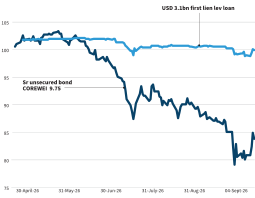
Source: S&P Global/IHS Markit data
Even before the US midterm election results, Elon Musk rattled markets when he posted on his social media site X that more than 200 AI cloud providers are facing “guppy-level death and consolidation”. Why? Because debt markets had almost entirely shut off access to money for any company that doesn’t have substantial revenue independent of AI data centres, Musk argued.
“We have not had exposure to neoclouds, even in the high yield market, because it’s our view that the neoclouds are really just plays on chips and GPUs,” said Matt Eagan, head of the full discretion team at Loomis, Sayles & Company. “Right now, there’s a shortage of GPUs, but we think that can get collapsed later on. People are starting to catch up with that notion.”
Those concerns failed to be allayed by Anthropic’s revealing to the public its financial picture that showed the huge scale of demand for AI. But lingering questions remain about future demand and profitability for the industry.
Scott Macklin, head of US leveraged finance at Obra Capital says demand will be greater than supply and neoclouds may need to buffer up on their equity cushions.
Supply constraints
“Even assuming significant efficiency gains, our research suggests compute demand continues to materially outstrip available supply,” said Macklin. “As lenders and counterparties focus more closely on leverage and liquidity, we expect equity to do more of the heavy lifting.”
Debt is still available for AI. Indeed, Musk touted the USD 40bn debt deal for SpaceX to finance GPUs. And CoreWeave’s leveraged loans, which are secured, are trading at far sturdier levels. The loan has priority on some collateral as well as amortisation features that makes them more attractive, according to market participants.
“The addressable market and the ability to finance these data centres and the ecosystem around these data centres is monumental,” said Stephen Ketchum, CEO of Sound Point Capital. “We’ve tended to be somewhat cautious as we look at data centre financing or GPU financing. We’ve elected to focus instead on the businesses that derive benefits from the data centre.”

A sharp reset in AI expectations could undermine corporate confidence
Torsten Slok
Chief economist
Apollo Global Management
But a more leery financing market could have far reaching consequences. AI infrastructure build-out has become perhaps the most important driver of the broader economy, said Macklin.
“A sharp reset in AI expectations could undermine corporate confidence, trigger a pullback in capex and weigh on GDP growth, just as higher oil prices, tariffs and tighter immigration restrictions push inflation higher, raising the risk of a stagflationary environment in which growth slows even as price pressures persist,” said Apollo Global Management’s chief economist Torsten Slok in his daily note.
