




Listen to the latest episode of Credit Exchange with Lisa Lee
Published in London & New York
10 Queen Street Place, London
1345 Avenue of the Americas, New York
Creditflux is an
company
© Creditflux Ltd 2026. All rights reserved. Available by subscription only.


Analysis
Apollo repurposes CLOs to generate wider spreads
by Lisa Lee & Kathryn Gaw
The next generation of CLOs may have just been birthed. On an earnings call last month, Apollo Global Management CEO Marc Rowan unveiled a novel concept called Apollo Multi-Asset Prime Securities, or AMAPS.
AMAPS, Rowan said, will essentially take the benefits of a CLO, but with a few key tweaks. The impetus to innovate came in response to tightening CLO spreads, says Bret Leas, head of asset-backed finance at Apollo, in an interview with Creditflux.
“The germination of the idea came from the top,” says Leas, who names Rowan as well as co-president John Zito. “Then we executed the vision.”
The strategy began in New York and, over the past year, a bevy of brains have been working hard to bring AMAPS to fruition. The remit was to create a product that was functionally similar to a BSL CLO, but with wider spreads, more obligors, and more diversified underlying collateral.
“It has to be north of 40% investment grade because that’s where our firm is going,” says Leas. “It has to be transparent, with 600-plus underlying positions that you can actively manage and make scalable.”
Deep single A stack
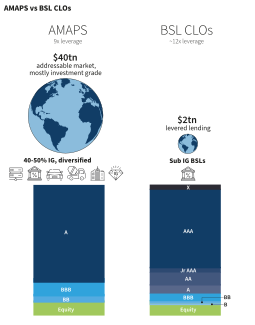
AMAPS have more than 600 obligors, rather than the 150-450 held within a traditional US BSL CLO. Approximately 75% of the assets underpinning AMAPS notes will be held in a thick single A stack, with a further 10% in triple Bs. Between 45% and 50% of the underlying assets are defined as investment grade.
According to a disclosure from Athene, Apollo’s retirement insurance subsidiary, the AMAPS single A tranche is clearing at SOFR plus 200bps. This is markedly wider than the current US BSL CLO benchmark of around 120bps for triple As, 145-150bps for double As, and 160-165bps for single As.
When choosing the individual credits, Leas says the team wanted to build a model for asset allocation following a levered format. The only constant is that the team has to believe in the underlying assets — it has to be something that the platform knows well.


It has to be transparent, with 600-plus underlying positions
Bret Leas
Head of asset-backed finance
Apollo
“That means you can be in loans, you can be in bonds, you can be in mortgages,” he says. “You can be in all the underlying building blocks of what we do.”
So far, Apollo’s investors have been responsive to this new product. Leas speaks of a group of “true strategic partners”, including sovereigns, pension funds and insurance companies, which have already engaged with the strategy. “Different levels of the stack may work for different investors,” says Leas.
At the time of writing, Apollo had completed approximately USD 20bn of AMAPS issuance across four vehicles.
This is not the first time that Apollo has rewritten the rules of structured credit. In 2015, Albert Huntington, head of structuring and advisory at Apollo’s CLO arm Redding Ridge, worked with Leas to create the CLO reset technology that has permanently transformed the market. Last year, reset issuance totalled around USD 200bn, accounting for nearly half of all deals in the US, according to Creditflux data.
Not all alternative credit shops will have the size and diversity of offering to issue AMAPS-style products, but Leas believes that in a world of stubbornly tight spreads and growing demand for diversified yield-producing credit products, the sector can only grow. He even predicts that banks will trade AMAPS notes.
Evolution is ongoing
“If you remember the CLO market pre-crisis, it was a trade-by-appointment market,” he says. “Now, more than USD 1bn trades every day. Some things take time.”
However, Leas insists that the existence of AMAPS does not mean Apollo is done with the CLO business. “CLOs and AMAPS will coexist, and allocation trends will follow the relative value at different points in time,” says Leas. “CLOs have been massively successful and they’re not going anywhere, but we think the IG spreads are too tight.
“We know the [CLO] technology works. It’s proven to work,” he adds. “We can use that technology in a broader way.”
