




Listen to the latest episode of Credit Exchange with Lisa Lee
Published in London & New York
10 Queen Street Place, London
1345 Avenue of the Americas, New York
Creditflux is an
company
© Creditflux Ltd 2025. All rights reserved. Available by subscription only.


News Analysis
Blue Owl’s unwise BDC merger rekindles liquidity risk worries
by Lisa Fu
A bungled attempt by Blue Owl to merge two of its credit funds highlights the risks wealthy investors in non-listed debt vehicles run in trading off the promise of consistent returns for limited liquidity.
Last month, Blue Owl proposed merging Blue Owl Capital Corporation II, which has USD 1.7bn in assets and is not publicly traded, with its big brother, OBDC, which trades on the New York Stock Exchange and has USD 17.1bn in assets.
The two business development companies (BDCs) have near identical portfolios. But while the non-listed BDC trades at net asset value (NAV), OBDC is subject to the vagaries of the public market.
As worries mounted across credit markets following high-profile bankruptcies such as First Brands, listed BDCs tumbled. Shares in OBDC slumped to a 20% discount to NAV.
Because Blue Owl was asking investors in the non-listed fund to exchange their holdings for shares in OBDC at the stated asset value of both funds, they faced a 20% loss. Investors duly revolted, and Blue Owl quickly scrapped the merger.
It began with Blackstone
Non-listed business development companies (BDCs) have become immensely popular since Blackstone launched its prominent semi-liquid, nontraded BDC Blackstone Private Credit Fund (BCRED), in 2021.
According to a report in May by consultants Cliffwater, these semi-liquid BDCs collectively held USD 127bn in net assets, exceeding the USD 112bn managed by traditional BDCs.
BCRED is the largest non-traded BDC with more than USD 80bn in assets, according to a 20 November report from investment bank Raymond James. It is followed by Blue Owl Credit Income Corp with over USD 34.7bn in assets and Apollo Debt Solutions with USD 24.6bn.
Closed end CLO equity funds: share price change YTD (%)
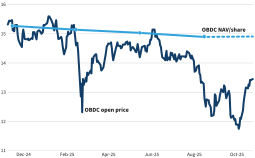
Source: Blue Owl OBDC filings; NASDAQ
These private vehicles were marketed to wealthy individual investors with the lure of steady, attractive returns, without the volatility inherent in a publicly traded vehicle. The funds were set up as evergreen vehicles, so investors did not have to plan for an eventual liquidation.
In return, investors have limited ability to sell their shares. Typically, shares can be sold quarterly, at the fund’s stated value, but total redemptions are restricted to 5% of a BDC’s asset base so that managers are not forced into a fire sale of loans in their portfolios.
The offer to buy back shares is voluntary, not an iron-clad promise. Indeed, non-traded BDCs also have the option to gate their funds at any time to better manage liquidity.
This raises the question of how fund managers will react if there is a flood of redemption requests. “A real test is going to be when we have a significant recession… when people are seeking liquidity over a prolonged period of time,” said Stephen Nesbitt, CEO of Cliffwater.

The real test will be when we have a recession
Stephen Nesbitt
CEO
Cliffwater
Publicly traded BDCs have sold off not only because of credit concerns but also because dividends are set to fall if the Federal Reserve keeps lowering borrowing costs. Among non-listed BDCs, BCRED said in its third-quarter shareholder letter that it was reducing dividends in anticipation of Fed rate cuts.
If non-traded BDC investors rush for the exit, fund managers face an unenviable choice. They can suspend the option to cash-in altogether, provide limited exit opportunities or offer immediate liquidity at a high cost — approximately 20% in the case of investors in the non-listed Blue Owl fund.
Alternatively, the BDC can put up a gate, trapping investors in the fund but protecting the vehicle’s net asset value.
“If investors start redeeming from non-traded BDCs the way retail investors sold listed BDCs, those effects won’t be seen until fourth-quarter results come out in March 2026,” said Larry Herman, a managing director at Raymond James. “Should redemptions exceed the typical 5% threshold, there’s a possibility a BDC could put up a gate.”
To date, no non-traded BDCs have had to gate their funds, although many have come close. In December 2022, redemption requests to BCRED reached the fund’s 5% NAV limit, but Blackstone fulfilled all the requests by tapping into extra liquidity the vehicle had on hand.
Offering higher dividends
Blue Owl argued that investors in its non-listed BDC would enjoy higher dividend yields if they voted for the merger because the public BDC did not operate under the same leverage constraints as its smaller twin.
Another rationale for the proposed transaction was that Blue Owl had promised investors in the non-traded fund a “liquidity event” — a chance to cash in their shares at once.
The firm still has more than a year to honour this pledge and is in no rush to find an alternative solution. “Different investors have different preferences,” said Logan Nicholson, a senior managing director at Blue Owl.
“If you want immediate intraday liquidity, the price for that is the volatility,” said Jack Shannon, Morningstar principal for equity strategies. “You have to eat the volatility on the good side and the bad side.”
