




Listen to the latest episode of Credit Exchange with Lisa Lee
Published in London & New York
10 Queen Street Place, London
1345 Avenue of the Americas, New York
Creditflux is an
company
© Creditflux Ltd 2025. All rights reserved. Available by subscription only.


Data Secondary
CLO secondary dynamics
The CLO market in November 2025 exhibited steady but shifting activity across trading and spreads, reflecting a market that remained active despite seasonal slowdowns and mixed sentiment
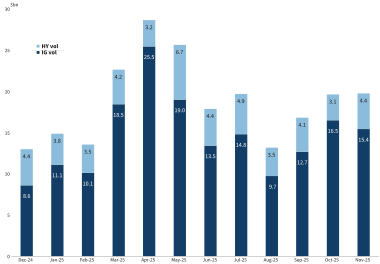
TRACE volumes remain flat at USD 19.8bn
TRACE volumes were broadly stable at USD 19.8bn, signalling consistent liquidity relative to prior months. HY volumes remained steady at USD 4.4bn.
The market continues to operate within a narrow range, though the balance between IG and HY shifted modestly as HY participation increased.
Last 12 months FINRA TRACE monthly reported CLO/CDO volumes
Daily TRACE reported trades
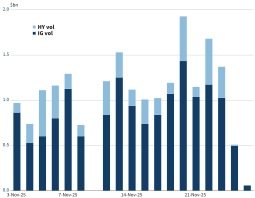
Daily TRACE volumes picked up between holidays, with 13 days exceeding USD 1bn in November
Notably, daily TRACE activity strengthened between Veterans Day and Thanksgiving, with 13 days surpassing USD 1bn, supported by average daily volumes of USD 856m in IG and USD 256m in HY, for a combined USD 1.1bn daily average.
This pickup reflects a combination of year-end positioning and improved liquidity in mezzanine and equity. HY traded as a share of TRACE rose to 18%, while IG fell to 10.5%.
This rebalancing shows buyers leaning into mezzanine risk as spreads widened in October and early November. HY participation is still well below the peaks seen earlier in the year, but appears to be stabilising.
HY traded volume rises to 18% as IG falls to 10.5%
BWIC activity in IG declined across all tranches. November volumes were lower than October for triple A, double A, single A, triple B and double B, and most segments also fell below their long-term averages.
The reduction in IG bid lists is consistent with managers locking in year-end NAV levels and reduced willingness from sellers to test the market after October’s repricing. HY and equity flow appears more resilient, supported by higher dealer appetite and fewer forced sellers.
Traded BWICs as a percentage of TRACE reported volume
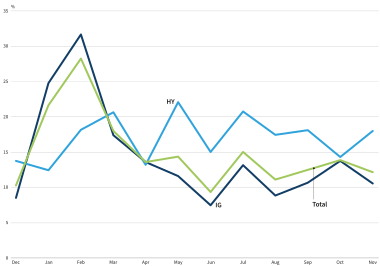
CLO BWIC volumes traded (US)
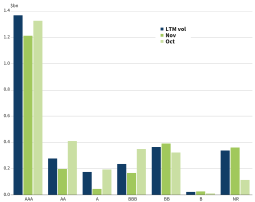
IG BWIC activity declined across all tranches MoM
Equity trading rose sharply. November printed USD 362m, a sizeable increase from October and one of the stronger months of 2025.
Year-over-year comparisons still favour 2023 in several months, but the most recent trend shows a recovery in demand for callable equity and short-duration opportunities. Managers continue to manage optionality around 2026 resets and refis, and equity buyers are selectively stepping in.
US equity traded- 2023 vs 2024 vs 2025
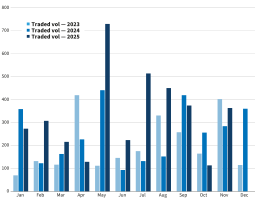
Equity volume rises in November to USD 362m MoM
Spread movements were mixed. Double A was the only tranche to tighten month over month, narrowing 14bp.
Other categories widened: single A tranches moved 28bp wider, triple B widened 9bp, and double Bs widened 35bp. Triple A spreads were essentially unchanged at 133bp. The overall tone reflects ongoing credit differentiation and limited primary market relief.

For further information, contact Jacob Krayn, head of business development, Kopentech: Jacob.Krayn@kopentech.com
Source for all data: Kopentech, TRACE
