




Listen to the latest episode of Credit Exchange with Lisa Lee
Published in London & New York
10 Queen Street Place, London
1345 Avenue of the Americas, New York
Creditflux is an
company
© Creditflux Ltd 2026. All rights reserved. Available by subscription only.


Analysis Insurance
CLOs prepare to ride insurance capital wave
by Kathryn Gaw
Regulatory reforms are opening the door to billions in new insurance capital, prompting CLO managers to develop bespoke structures to capture growing institutional demand
The insurance capital market is changing, and CLO managers across the world stand to benefit. Regulatory updates in the UK, EU, US and APAC markets are making it easier than ever for insurers to invest in CLOs. In response, CLO managers are developing new structures that accommodate these insurers’ particular investment requirements. The prize is potentially a substantial new source of institutional capital.
CLO managers have already started to work on new types of CLO products that have been designed to meet insurer demand. These include longer-dated CLOs, new CLO variants such as Apollo’s Multi-Asset Prime Securities (AMAPS), hybrid private credit/broadly syndicated loan CLOs, and multi-currency deals.
“There are certain managers embracing those newer investors and putting together structures that satisfy the asks of that investor base,” says Andrew Lawson, head of capital markets and CLO business at NorthWall Capital.

“All this is positive because the more investors that come into the CLO marketplace, the more liquid it becomes as a liability marketplace, from triple As all the way down to single Bs. It also makes the market more resilient to weather the economic ups and downs that we’ve had.”
Attracting insurer capital has become of one of the main talking points at industry gatherings in the year to date, as managers spoke about the potential of this wave of new capital entering the market next year. Laila Kollmorgen, global head of CLO tranche investments, MetLife Investment Management, notes that in Europe less than 1% of the insurance market is currently invested in securitisations, including CLOs, adding that “the potential of moving into this market is massive”.
According to data from the European Insurance and Occupational Pensions Authority (EIOPA), by the end of 2025 European insurers held total investment assets of EUR 9.9tn. The UK market adds another GBP 1.1tn to this, according to data from the Investment Association. If another 1% of this insurer capital was invested into European CLOs, it would effectively increase the size of market by a third. For managers, it pays to cater products to an insurer investor base.


The more investors that come into the CLO marketplace, the more liquid it becomes
Andrew Lawson
Head of capital markets and CLO business
NorthWall Capital
What is changing?
The biggest regulatory changes are happening in the UK and European markets, where Solvency II will soon usher in a new set of investment rules for insurers that could prove transformative for the continent’s CLO market. One of the key elements of the Solvency II reforms is an update to the Standard Formula used by insurers, which will effectively reduce the capital charges on investments into senior CLO tranches. This could also create an opportunity for CLO tranche managers, Kollmorgen says.
“From the surveys conducted by consulting firms, up to 85% of insurance companies who use the Standard Formula under Solvency II will be looking to hire CLO tranche managers to handle the separately managed accounts (SMAs), as there is significant look-through and reporting required by the regulator,” she says.
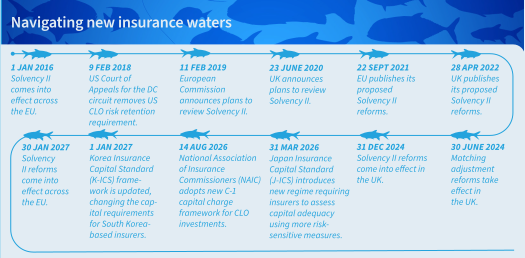
The revised Solvency II framework takes effect across the EU at the end of January 2027, and it has the potential to unlock billions of euros in new capital for CLO strategies. The revised rules reduce the capital requirements for certain securitisation positions, while the updated matching adjustment mechanism effectively encourages insurers to hold assets with predictable cashflows. Triple A CLO tranches can comfortably meet these definitions, while also demonstrating a long track record of resilience through periods of macroeconomic volatility.

The potential of moving into this market is massive
Laila Kollmorgen
Global head of CLO tranche investments
MetLife
In the UK, Solvency II reforms came into effect at the end of 2024. This early adjustment to the incoming EU rules has led to a huge rise in demand for certain types of CLOs — particularly those materially exposed to private credit assets — according to Dan Tobias, a partner at Orrick. These investors are passing their requirements on to arrangers and lawyers, who are helping CLO managers to structure products designed to meet their specific needs. “For example, there may be relatively more of an original issue discount (OID) component to the yield and a relatively smaller spread component, which reduces the incentive to refinance if spreads tighten,” says Tobias.
Tobias has also seen some CLO managers turning off the deferability of the tranches to make the cashflow more predictable, in line with the matching adjustment rules.
“Structural features that permit the payment frequency of interest to be changed can also be turned off and make-whole payments may apply in the case of early redemption,” he adds. “These can all help improve predictability of cashflows, but the mix of features will ultimately be driven by the particular requirements of the investor.”
By coincidence, 2024 was also the year that the first European private credit CLO was issued, by UK-based CLO manager Barings. This initial print was followed by another European private credit CLO from Barings, two direct lending deals from Ares and a European PC debut from Golub. Earlier this year, Sona Asset Management issued the market’s first PC/BSL hybrid CLO and more of these vehicles are expected to be printed in the coming months and years.
Insurers are attracted to the risk-adjusted yield offered by PC CLOs, and this is helping to drive demand for more bespoke approaches to CLO structures. Ares’ second direct lending CLO was created for insurance investors. So too was Golub Capital Partners Long Duration 2025-1 — a US PC CLO issued in September 2025 with a reinvestment period of 10 years. In September 2026, TPG issued a US PC CLO with a 6.5-year reinvestment period, raising the prospect of more long-dated prints in the future designed to appeal to the long-term investment goals of global insurers.
Testing the waters
More and more European CLO managers have been talking more openly about creating products for the insurance segment, while others have told Creditflux that they are watching what their peers are doing to determine which of these structures do and do not work before investing in their own insurer-targeting strategies.
The insurance opportunity isn’t unique to Europe. Korean regulators are also preparing to ease their capital requirements in a move that could unlock billions of dollars for CLO investments (see box). Japan is moving a little more slowly towards a similar position. And then there is the US.
In August 2026, the National Association of Insurance Commissioners (NAIC) adopted a new C-1 capital charge framework for CLO investments that effectively reduces the capital charges associated with CLO investments. This, combined with the risk retention exemption passed in 2018, has made it easier than ever for insurers in the US to increase their CLO exposure, across almost all tranches. “The lower risk-based capital charges only make the asset class more attractive,” says Kollmorgen.
These US insurers are now also eyeing the European CLO market in search of diversification and better yields. However, there are a few hindrances to these plans, namely currency risk. US life insurers hold their liabilities in USD, and there are limited USD-linked opportunities for CLO investors into Europe. Creditflux is aware of at least one USD/EUR multi-currency CLO which is currently in progress, with the aim of reducing the currency risk burden for US life insurers and attracting this new capital.
An even more bespoke insurance-attracting CLO structure has already reached the market and is gaining traction with other managers. Apollo launched AMAPS in May of this year, with CEO Marc Rowan pitching the vehicles as the ‘next generation’ of CLOs. AMAPS have been structured specifically to appeal to insurers — Apollo’s sister company Athene has been the largest investor in the vehicles to date. AMAPS offer more diversified collateral then traditional BSL CLOs and a larger proportion of investment-grade loans, which meets the criteria for reliable cashflows. KKR is known to be working on a similar product of its own, while other managers are believed to be exploring the concept as well.
Relationships bring advantages
Managers who have established relationships with insurance companies may have an advantage in this new era, as they understand the insurers’ liability profiles, the regulatory capital constraints, their credit requirements and their preferences around duration and liquidity. Some — such as Apollo — may also have access to a ready-made investor base which can help with repeat issuance. To date, six AMAPS vehicles have already been issued, and the product is now also available to third-party investors.
Others, such as Blackstone, prefer to work with third-party insurers rather than buying their own insurance company in the style of Apollo and KKR. Blackstone recently confirmed to Creditflux that it has no plans to acquire its own insurance company, but the firm appears committed to working alongside insurers by issuing deals such as the upcoming European hybrid CLO which appeal to their capital and liquidity requirements.
Bespoke structures such as hybrids, multi-currency deals, long-dated CLOs, and AMAPS-style vehicles are gaining popularity across the market, and even more innovation is expected to follow as the global insurance capital market continues to open up.
While the global insurance reforms differ in the fine print, they all have the same objective — to allow insurers greater flexibility to invest, while maintaining the necessary safeguards around cashflow matching, credit risk and policyholder protection.
MARKET VIEW
The emerging APAC opportunity
APAC insurers may soon be on the lookout for new CLO investment opportunities, thanks to a series of regulatory changes being introduced in South Korea and Japan.
On 1 January 2027, the Korea Insurance Capital Standard (K-ICS) framework will be updated, changing the capital requirements for South Korea-based insurers.
Following the update, these insurers will be required to pay closer attention to the amount and quality of capital they hold against their investments. This could encourage insurers to favour more senior, lower-risk and capital-efficient CLO tranches over riskier junior tranches.
In April 2026, Korean regulators also announced plans to expand the use of matching adjustments from the current 100% match in the cashflows of assets and liabilities. Under the new proposed rule, regulators will follow in the footsteps of regimes
like the UK by allowing for discrepancies of up to 10% for floating-rate assets such as CLOs. This too could help encourage more investments in the CLO market.
According to a recent report on insurance company business performance published by South Korea’s Financial Supervisory Service (FSS), at the end of December 2025 the Korean insurance industry held total assets of KRW 1,344.2tn, or just under USD 1tn.
Meanwhile, Japan has also introduced a significant change to its insurance regulatory framework that could affect how Japanese insurers invest in CLOs, and push insurers towards more senior CLO tranches.
On 31 March 2026, the Japan Insurance Capital Standard (J-ICS) introduced a new solvency regime that looks more closely at the economic value of insurers’ assets and liabilities, and the risks that they carry.
Insurers must prove that they understand the risk of each CLO tranche, potentially making senior, longer-dated and lower-risk tranches more attractive. Further refinements to the Japanese insurance market are expected but not imminent.
