


Listen to the latest episode of Credit Exchange with Lisa Lee
Published in London & New York
10 Queen Street Place, London
1345 Avenue of the Americas, New York
Creditflux is an
company
© Creditflux Ltd 2026. All rights reserved. Available by subscription only.


News Analysis
Direct lenders hit hard as credit market reels from war and AI
by Lisa Lee & Lisa Fu
Volatility has come back to credit markets. Artificial intelligence’s impact on corporate earnings, a war in Iran that is ensnaring the rest of the Middle East and upticks in inflationary pressures are weighing on managers.
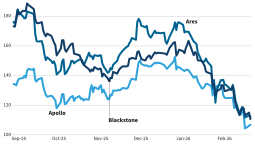
The private credit market, with its outsized exposure to the software industry, has been hardest hit. Shares in Apollo, Blackstone and Ares are down more than 25% this year. Blue Owl is off more than 30% after investors responded poorly to an aborted merger of two of its BDCs and a sale of USD 1.4bn in assets to institutional investors.
Software firms were once the darlings of leveraged finance. They have good revenue visibility, variable costs, and high margins — which made lenders comfortable with piling on more debt than for other sectors. Now that’s come back to bite.
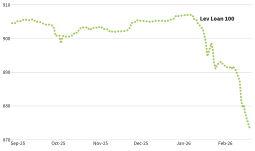
1: Morningstar LSTA US Leveraged Loan 100
“They’ve benefited from a lot of tailwinds in terms of good growth and rising multiples over a long period. So it’s been a comfortable place for a lot of folks to lend,” said Jeff Kivitz, chief investment officer at Canyon Partners. “Those tailwinds are becoming headwinds.”
Retail outflows from private credit funds are rising, though institutions remain keen. Blackstone’s flagship private credit fund, BCRED, which caters to affluent individuals and has amassed USD 82bn in assets, saw redemption requests spike to 7.9% in the first quarter. Despite the ability to gate at 5%, Blackstone opted to pay out all the requests — with an additional USD 400m contributed by employees and the firm.
2: Private credit manager share price (USD)
“Software loans are the poster child for AI disruption anxiety, but they’re just the most visible casualty,” said Scott Macklin, head of leveraged finance at Obra Capital. “The same existential questions apply across a much wider swath of the loan universe. Software is simply where the market chose to price the fear first.”
The direct loans underlying BDCs are also showing trouble. BlackRock TCP reported markdowns that wiped out 19% of the BDC’s net asset value quarter-over-quarter. Notably, it wrote down its position in Amazon aggregator Razor Group to zero. Apollo’s listed BDC MidCap put three new names on non-accrual, accounting for 36% of its fourth quarter net loss. FS KKR, the listed BDC managed by KKR and Future Standard, took its first AI-related hit on Lionbridge Technologies.
Underlying fundamentals are good
Joel Holsinger
Co-head of alternative credit
Ares
Ares’ co-head of alternative credit Joel Holsinger noted emergent signs of stress in credit markets on the ‘Credit Exchange with Lisa Lee’ podcast.
“Right now, we’re in the situation where the tide has not gone out. That’s very clear,” he said, referencing Warren Buffett’s famous line. “Underlying fundamentals are generally good. But you’re seeing some random nudity on the beach.”
Leveraged loans/CLOs
The leveraged loan market has not been spared. Software loans, which have been on the decline throughout 2026, took a major step down at the end of February on AI disruption fears.
“We will watch software loans and other AI-impacted loans closely, but I’m comfortable with our positions, because as a triple A CLO liability investor, we get tons of subordination and have industry diversification,” said Investec’s Michael Schewitz, who invests in high-grade tranches of private credit CLOs. “CLO equity and lower mezzanine, on the other hand, is contingent on many things.”
Banks are finding it harder to sell leveraged loans, and prospects loom for hung deals or deep new issue discounts, said sources. CLO deal activity has been slowing.
“Given the cross-currents around AI, we have been patient in ramping,” said Guggenheim’s global head of CLOs, Robert Zable, on issuing new deals.
Then, on 28 February, the US and Israel bombed Iran, leaving dead Supreme Leader Ayatollah Ali Khamenei. Iran’s response has roiled markets, which worry that a prolonged conflict will cause a surge in energy prices and stoke inflation.
CLO liability prices, which had been stable and indeed tightening, have begun to widen following the eruption of war in the Middle East. At press time, CLO liabilities in the secondary market had increased between 10-15bps, said sources, who expect further widening and a slowdown in issuance if the conflict is prolonged.
