


Listen to the latest episode of Credit Exchange with Lisa Lee
Published in London & New York
10 Queen Street Place, London
1345 Avenue of the Americas, New York
Creditflux is an
company
© Creditflux Ltd 2026. All rights reserved. Available by subscription only.


Analysis Private credit
Direct lending braces for redrawn landscape
by Ben Watson, Debtwire
After a stellar 2025, direct lenders are coming under pressure. Large-cap financings are colliding with record tight spreads in public markets, while competition is rising in mid-market lending
2025 was a banner year for European direct lending. Issuance hit alpine heights, with some EUR 115bn deployed across 1,357 transactions. Setting aside add‑ons, issuance climbed to EUR 95bn across more than a thousand deals.
Number of European deals/investments in 2025
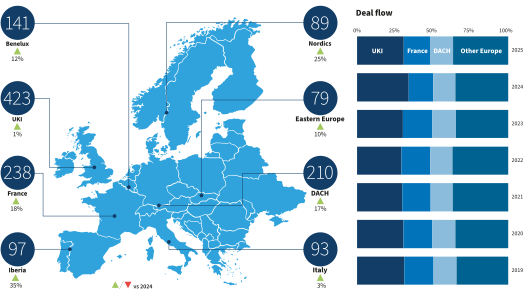
Source for all data: Debtwire
Direct lending proved a sure-fire route to raising levered debt. Captive capital and certainty of deployment conveyed a sense of roped-in security at a time when public market volatility made traditional financing pathways unviable. The final quarter of the year contributed EUR 27.1bn across 354 deals, with activity softening slightly from the exceptionally strong third quarter, but still surpassing the previous year’s Q4 deal count.
115
bn
€
Deal volume in 2025 — a 23% rise in volume versus 2024
Refinancing issuance dominated volumes, accounting for nearly half of all direct lending deployment in 2025. The consistent flow of new money was the standout feature of the direct lending market, and this was despite restricted overall deal flow in leveraged capital markets.
Large‑cap margins tightened most
Pricing dynamics were heavily shaped by competition in the public credit markets. Average unitranche margins finished the year around 521bps, having hit a record tight in the second quarter at 517bps. Rates, however, were increasingly differentiated by market cap: large‑cap margins tightened the most, converging toward public market levels and chipping away at the long-standing liquidity premium that direct lenders had enjoyed. The mid‑market and small‑cap segments continued to offer more attractive spreads and firmer footholds.
1,357
New deals in 2025 — an 11% rise in deal count versus 2024
This set the stage for one of the ongoing trends into 2026: a strategic rotation by traditionally large‑cap direct lending funds into the mid‑market. With margins in the EUR 1bn‑plus segment tightening due to a more active syndicated loan market, managers are increasingly redeploying origination resources toward EUR 30-75m EBITDA borrowers, where spreads are wider, documentation is more lender‑friendly, and competition is lower.
The mid-cap migration is already reshaping the landscape, with more clubbed mid‑market unitranches involving lenders that, until recently, concentrated almost exclusively on EUR 200m‑plus underwrites.
Debt-for-equity swaps count hits new heights
Direct lending vs public leveraged market
Both public and private credit markets deliver strong 2025 volumes
Outsize impact of software companies
A further dynamic weighing on the direct lending market is the move away from AI-impacted software companies. Last year’s data shows just how important this is for direct lenders, with EUR 63.7bn deployed in 2025 to technology firms — over 55% of total volume.
These trends point to a 2026 roadmap in which large‑cap direct lending deployment will be dialled back as long as public markets remain available to provide capital at tighter spreads. The mid‑market may become a conga line as capital from lenders typically confined to the largest deals flows downstream. Nevertheless, direct lending continues to defy the naysayers who predict its downfall. Core mid‑market direct lending is sure to survive, though lenders are likely to experience a squeeze.
European direct lending volume
Sector breakdown 2025
Source for all data: Debtwire
