




Listen to the latest episode of Credit Exchange with Lisa Lee
Published in London & New York
10 Queen Street Place, London
1345 Avenue of the Americas, New York
Creditflux is an
company
© Creditflux Ltd 2026. All rights reserved. Available by subscription only.


Analysis ETFs
CLO ETFs achieve milestone moment
by Kathryn Gaw
CLO ETFs are surging past USD 50bn, opening the asset class to a much broader investor base and accelerating growth in Europe, but changing market conditions could test performance
Just six years after collateralised loan obligations (CLOs) gave birth to their first exchange-traded fund, this infant market has shot past the USD 50bn dollar mark and looks set for another growth spurt.
ETFs based on baskets of corporate loans made their debut in the US at the turn of the decade, offering broader access to an asset class previously reserved for institutional investors, with the prospect of attractive returns from high-yielding, floating-rate debt. The rapid growth of CLO ETFs outpaced most expectations, and the funds are spreading overseas, with Europe as the emerging hotspot.
The consensus forecast is for continued expansion, as providers pile in with CLO ETFs of various types, but the next phase is not entirely without its risks. Aside from the supply bulge, a shift in economic conditions could affect performance, and some smaller funds may fall by the wayside as the market matures, industry sources say.
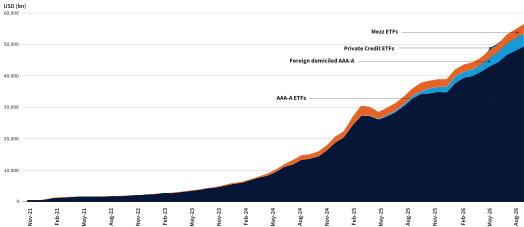
The trajectory so far has been sharply upwards, pushing the US CLO ETF market past USD 50bn of assets under management this year, according to Bank of America data.
The trailblazer was AXS First Priority CLO Bond ETF, launched in September 2020, swiftly followed by Janus Henderson’s ground-breaking JAAA vehicle. Today, JAAA alone holds more than USD 30bn in net assets, making the firm by far the biggest player in the market.
CLO ETF AUM
Source: BofA Global Research
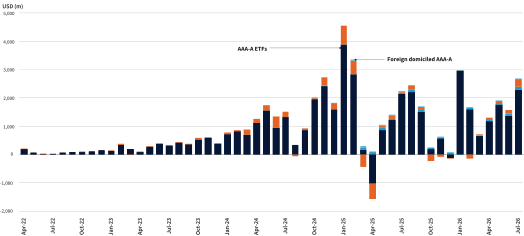
CLO ETF Flows
Source: BofA Global Research
And investor interest shows little sign of abating. John Kerschner, global head of securitised products and portfolio manager at Janus Henderson, told Creditflux that the flagship fund has drawn in more than USD 5bn in the year to date.
Could the ETF even achieve USD 50bn in its own right? “Sure, the market’s big enough,” says Henderson. “I think that there’s enough demand for a high-quality floating rate yielding product like JAAA.”
ETFs serve to widen the investor base for CLOs, tapping wealth channels while offering institutions a more liquid version of pooled loans. Traded on stock exchanges, the ETFs give retail investors a route into the rarified world of floating-rate fixed income. The evolving market is spawning a widening range of products from triple A and investment-grade funds to lower-rated issues.
Top-tier CLO tranches backed by broadly syndicated loans (BSLs) have performed well versus standard corporate debt in terms of defaults or losses since their inception more than 25 years ago, making the related funds attractive for investors aiming to build a broad credit portfolio, says Cathy Bevan, co-head of Europe and global head of structured credit at Benefit Street Partners. “ETFs make it easier for them to gain this exposure.”
Unlike BSL CLOs, the funds provide the benefit of intraday liquidity and have a much lower investment threshold.
They also offer a proxy for products of shorter duration and have outperformed several other income ETFs in risk-adjusted returns over the past six years, says Pratik Gupta, head of CLO research at Bank of America. “I think that has added to the allure for more investors to actually consider this as a core portion of their portfolio.”
Europe as growth engine
Fund providers are now jostling for a piece of the European action. Two years after the region’s first such fund, Fair Oaks AAA CLO ETF, was launched with EUR 161m in assets, the market has surged past EUR 2bn, with products from the likes of Invesco, Muzinich, Palmer Square, Benefit Street Partners, State Street and Blackstone.
Meanwhile, Reckoner and Barings are both believed to be preparing to join in. Reasons to invest in CLO ETFs include ratings stability, the relatively remote risk of losing the principal, superior returns relative to corporate bonds, and increasing secondary market liquidity, says Matthew Wardle, M&G’s portfolio manager for the recently launched AAA EUR CLO Active UCITS ETF.
His team decided the time was right for the fund after detecting a growing appetite for dedicated CLO allocations, as opposed to broader, cross-sector strategies.
Janus Henderson’s flagship European product JCLO has sprinted to EUR 622m. Its Europe-compliant JAAA stands at EUR 390m.
But the European market comes with distinct challenges. Tighter rules on investor protections and financial transparency could limit expansion there, although some in the industry hope proposed changes to European Union securitisation regulations could ease compliance and boost liquidity.
Funds sold in the EU need to comply with UCITS safety rules and, under another provision, must formally identify the type of target investors. As a result, many European CLO ETFs are marketed to ‘advanced’ or ‘sophisticated’ investors.
UCITS-compliant ETFs are also widely accepted in Asia and South America, which could explain the surge in European versions of US CLO ETFs.

Could JAAA’s ETF achieve USD 50bn in its own right?
John Kerschner
Global head of securitised products and portfolio manager
Janus Henderson
Emmet Quish, partner in the global investment funds group at law firm Walkers Global, is expecting more managers to launch European CLO ETFs, in some cases using turnkey systems known as white-label platforms that handle set-up and administration.
“These platforms have materially lowered the barriers to entry and shortened time to market for CLO managers seeking to enter the ETF space, which has in turn accelerated the pace of new product launches,” Quish said.
Meanwhile, Gupta expects to see more innovation going forward, generating a growing variety of securitised ETFs that would increase investor choice and flexibility to move between fixed and floating rates.
Still, confidence among retail investors — even those who identify as sophisticated — can be brittle. A recession with a wave of loan defaults and downgrades of lower-rated tranches could spook some investors, hampering growth. But most market participants confidently expect the funds to keep going from strength to strength, with little in the way of downside risk.
Janus Henderson’s Kerschner would not be surprised to see the European CLO ETF market doubling in size over the next year or so.
“There are now 55 or 56 different CLO ETFs globally, which is kind of shocking,” he says. At the time of the JAAA launch, Kerschner might have predicted a much smaller number in the range of 10 to 15 global funds, underestimating the market potential.
However, many smaller ETFs have assets of USD 100m or less and may not have the same staying power as the giant funds.
“I would expect in a few years that we’re not going to be 55 or 56 anymore,” says Kerschner. “Some of these will eventually go away because they’re just not growing and the market does not need that many.”
