




Listen to the latest episode of Credit Exchange with Lisa Lee
Published in London & New York
10 Queen Street Place, London
1345 Avenue of the Americas, New York
Creditflux is an
company
© Creditflux Ltd 2026. All rights reserved. Available by subscription only.


Sponsored by Entegra
Phantom Premium – Part 2: Quantifying the visibility premium in AAA CLOs
by Daniel Ezra, Founder & CEO, Entegra
In part 1 of Phantom Premium (Creditflux, Apr 2026), we showed that the persistent spread premium in triple A CLOs relative to investment-grade corporates reflects liquidity perception driven by differences in secondary market visibility. Corporate credit trades in continuous and observable markets, while CLO liquidity remains episodic and dependent on BWICs.
Roughly 60% of corporate and leveraged loan issuers are quoted on an average day, compared with only about 8% of CLO deals. That said, triple A CLOs can trade in size, including during periods of stress, but investors cannot continuously see where the bonds will clear or how much size the market can absorb before they need to sell. Part 2 asks what that difference in visibility is worth in spread terms.
The first step is to put the comparison on a consistent spread basis. We anchor to CDX.IG, the index most participants use to hedge and benchmark triple A CLOs.
CDX.IG carries an average rating around single A, several notches below triple A, so leaving it unadjusted makes the measured premium conservative. As a cash market cross-check, we use VCSH, the Vanguard Short-Term Corporate Bond ETF.
VCSH trades wider than CDX.IG, reflecting its rating mix and the difference between cash bonds and the liquid index.
Arriving at the Phantom Premium
Illustrative base case. Values in basis points
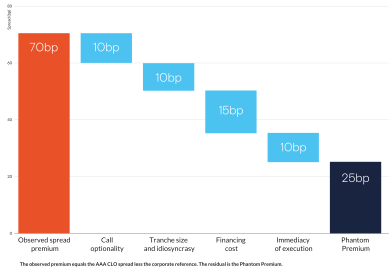
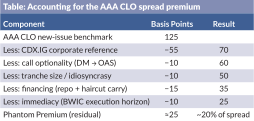
Allowing for those differences produces an implied triple A cash level broadly consistent with CDX.IG. With CDX.IG around 55bps and our triple A CLO new issue benchmark1 around 125bps, the observed spread premium is roughly 70bps.
But the 70bps premium is the starting point, not the answer. The CLO market has long debated why triple A spreads remain where they are.
Some point to regulatory treatment, others to complexity, financing, yield, market technicals or liquidity. These explanations are usually discussed together but rarely separated or assigned a value.
First, we estimate the cost of call optionality at 10bps. A typical new issue CLO has a five-year reinvestment period and two years of call protection, after which it can be refinanced, reset or called at par. This creates reinvestment risk for the triple A investor when spreads tighten. Corporate bonds can also be callable but make-whole protection generally makes that option a far less valuable one to the issuer.
Because discount margin does not isolate the value of the refinancing option, we model triple A cashflows across a range of future spread scenarios using the broad framework described by Santander.2 We assume the CLO is refinanced when the savings justify the transaction cost.
On that basis, a new-issue triple A tranche quoted at a discount margin of 125bps has an estimated OAS of approximately 115bps.
Second, we assign 10bps to tranche size and idiosyncrasy. Triple A CLO tranches are generally a few hundred million dollars, rather than the multibillion-dollar benchmark issues common in corporate credit. Their smaller size limits the buyer base, while the analysis required for each structure makes the bonds less interchangeable. Because there is no directly observable spread for this difference, we use the midpoint of a 5bps to 15bps range.3
The Phantom Premium costs CLO Equity more than USD 2bn a year
Daniel Ezra
Founder & CEO, Entegra
Third, we estimate the financing disadvantage at 15bps, based on the higher cost of financing triple A CLOs relative to investment-grade corporate credit. Corporate investment-grade repo is typically 20bps to 30bps with haircuts of 3% to 5%, while triple A CLO financing is closer to 60bps to 75bps with haircuts of 7% to 10%.
At the midpoint of those ranges, the combined effect of the higher repo rate and additional haircut implies a financing disadvantage of approximately 60bps for a fully financed investor. We apply one quarter of that amount to reflect a marginal buyer that is partly financed.
Fourth, we assign 10bps to immediacy. A BWIC provides access to liquidity, but not the same certainty as a continuous market. Execution takes time, the number of buyers is not known in advance and the clearing level is established only when bids are submitted.
This allowance reflects that execution horizon and uncertainty. This leaves a residual of 25bps, or 20% of the triple A CLO spread. That is the Phantom Premium. It is the price investors charge when they cannot see where risk will clear, how quickly or in what size.
And the cost is ultimately borne by CLO equity. The residual may also capture capital treatment, extension risk and technical supply and demand. But the estimate is conservative in one important respect; financing and immediacy, which we account for separately, are themselves consequences of limited visibility.
The important conclusion is that a material premium remains after making reasonable allowances for the factors the market already prices, and that limited visibility appears to explain a meaningful part of it.
The premium persists today because the current market structure reinforces itself. Visibility drives accessibility, and accessibility supports liquidity. Dealers concentrate on paper where demand is easiest to identify, while investors gravitate toward bonds that already trade.
That limits participation by systematic and macro investors, who require reliable pricing, efficient financing and confidence that they can exit. Their absence narrows the marginal buyer base and concentrates liquidity in the most visible part of the market.
And the cost adds up. Triple A tranches represent roughly 65% of the USD 1.3trn CLO market, so at our 25bps estimate, the Phantom Premium costs CLO equity investors more than USD 2bn a year.
Over five to six years, that equates to approximately USD 11bn to USD 13bn of additional excess spread that could otherwise accrue to CLO equity before discounting.
Recovering even part of that cost requires more than an active BWIC market. BWICs account for more than half of historical CLO TRACE volume and move risk effectively, but they do not keep bonds visible between auctions.
Continuous secondary market support would give investors clearer pricing and greater confidence that they can exit, broadening the buyer base and, over time, narrowing the Phantom Premium.
1 Entegra, U.S. CLO New Issue AAA Benchmark, available as downloadable benchmark data
2 Santander US Capital Markets, “Trading the Option Adjusted Price of Premium CLO Debt,” Portfolio Strategy, April 5, 2024
3 Long Chen, David A. Lesmond and Jason Wei, “Corporate Yield Spreads and Bond Liquidity,” The Journal of Finance, Vol. 62, No. 1, February 2007, pp. 119–149.
ENTEGRA’S TRADING-AS-A-SERVICE (TaaS):
FROM EPISODIC LIQUIDITY TO CONTINUOUS VISIBILITY
The solution
Entegra is built to address the structural gap in SP by facilitating daily observable markets.
Entegra’s TaaS embeds within partner banks to deliver actionable pricing and execution certainty without requiring additional dealer balance sheet.
Over time, greater visibility will support broader accessibility, deeper liquidity and tighter spreads.
The structural impact
For issuers:
- Improve secondary market visibility and perceived liquidity for your platform
- Strengthen new issue pricing of your deals
- Daily frequency of credible and actionable exit pricing
- Improved speed of execution with less reliance on BWIC driven liquidity
info@entegra-global.com
www.entegra-global.com
+1 212 500 8303