




Listen to the latest episode of Credit Exchange with Lisa Lee
Published in London & New York
10 Queen Street Place, London
1345 Avenue of the Americas, New York
Creditflux is an
company
© Creditflux Ltd 2026. All rights reserved. Available by subscription only.


News Analysis
CLO managers brace for software loan maturity wall
by Kathryn Gaw
Underperforming software loans that will mature in 2028 are causing sleepless nights for CLO managers.
“At least half of that 2028 maturity wall was put together in much looser financial conditions,” says Michael Htun, head of CLOs and structured credit at Kartesia. “And you do start to think, if they haven’t already refinanced the debt in what has been a benign default environment and a tight credit spread environment, then there’s probably a reason for that.”
In the post-Covid years, software companies were highly attractive due to their high revenues and growth potential. But technology moves at pace, and the past five years have seen AI go from an esoteric curiosity to a disruptive force that threatens to undermine many software-based business models.
According to Fitch data, as of February 2026, technology-software was the top industry for broadly syndicated loan CLOs in the US, with exposure of around 13%. Even then, the percentage of these loans classified as distressed was believed to be in the double digits. Under normal market conditions, managers would refinance, but this is becoming increasingly difficult.
Collateral maturity profile for EMEA CLOs rated by Moody’s (%)
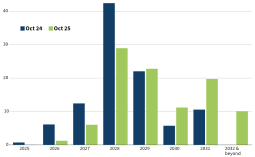
Maturity wall is a catalyst
“As you get closer to that maturity wall, that will act as a catalyst and [managers] will have to consider something like an amend and extend,” says Htun. “I think an increasing proportion of those borrowers may have to come up with some creative solutions, so you may see a pick-up in distressed debt exchanges or LMEs.”
Htun adds that, as a result, Kartesia would much rather play in the new issue, longer-duration space, than have a lot of exposure to the 2028 maturity wall. This is a view echoed by other investors in off-record conversations. They have expressed concerns about the prospect of low recovery rates, particularly in the SaaS subsector, which is asset-light.
While US CLOs tend to have more exposure to this part of the market, European CLOs are not immune to this risk.
“Collateral maturities for European CLOs are heavily skewed toward 2028 and beyond, increasing sensitivity to refinancing conditions,” says Javier Hevia Portocarrero, senior credit officer at Moody’s.
According to an October 2025 study on speculative grade refinancing risk by Moody’s, approximately USD 294bn of rated EMEA speculative grade debt matures in 2028. That is the largest single year in the 2026-29 period. The ratings agency has reported that software in European CLO portfolios represents around 6% of collateral.

Borrowers may have to come up with some creative solutions
Michael Htun
Head of CLOs and structured credit
Kartesia
“Although borrower liquidity has improved on average, refinancing conditions remain uneven, particularly for weaker credits,” says Hevia Portocarrero. “As a result, CLO investors and managers are increasingly focused on whether borrowers will be able to refinance smoothly as that peak approaches, especially if rates, spreads or risk appetite become less supportive.”
A lot of these deals will start launching some form of refinancing 18-24 months ahead of maturity, and so it will soon become apparent which managers are or aren’t able to refinance. One manager has described 2026 as “the year of reckoning” when strong investor relationships and intensive risk management will be rewarded. However, there is a ticking clock in the background of these refinancing discussions — it is only a matter of time before the rating agencies start issuing downgrades.
A recent analysis from BNP Paribas noted that 55% of software loans in the US and 45% of such loans in Europe are rated B-, with between 15% and 20% set to reach maturity before the end of 2028.
“We view this part of the market as most vulnerable to refinancing risks in the medium term,” the BNP Paribas report stated. A downgrade of a BBB tranche to BB could lead to selling pressures from rating-sensitive investors, BNP added, although this scenario would still be “manageable for the market”.
In a scenario of 50% of software downgrades to CCC, only around 17% of BBB tranches would be downgraded, BNP predicted.
Trouble in private credit
Private credit CLOs are particularly vulnerable to this downgrade risk, with market sources suggesting that some portfolios currently hold software exposure of between 20% and 30% — more than double the average exposure in the rest of the CLO market. Some private credit funds have seen substantial outflows over the past two months.
The overarching view is that there will be clear winners and losers in this space, and it will become much more difficult to hide poor underwriting as the maturity wall draws closer and downgrade activity begins.
Managers will find themselves in the unenviable position of attempting to refinance in a challenging economic landscape, and with a bearish investor base.
