




Listen to the latest episode of Credit Exchange with Lisa Lee
Published in London & New York
10 Queen Street Place, London
1345 Avenue of the Americas, New York
Creditflux is an
company
© Creditflux Ltd 2026. All rights reserved. Available by subscription only.


News Analysis
Investors seek safe havens as volatility rocks CLO ETFs
by Kathryn Gaw
CLO ETF managers are seeing a flight to quality as investors react to recent market volatility by pulling funds from mezzanine tranches and investing more heavily in triple As.
Jessica Shill, portfolio manager on the securitised credit team at Janus Henderson Investors, noted that while bank loan funds and mezzanine CLO ETFs have seen the most outflows since the end of January, triple A focused ETFs have seen inflows.
“You’re seeing rotations from mezzanine CLOs up the capital stack to the triple A portion,” she said. “And I think that’s healthy and kind of what you would expect investors to do in these markets. It’s great that you have CLO ETF vehicles across the capital stack and not just in one small portion of the CLO market.”
She described this as a “flight to quality” as investors respond to ongoing market volatility caused by the software sell-off and the Iran war.

Topping up in triple As
Michael Craig, managing director and head of European senior secured loans at Invesco, believes that investors in triple A CLO ETFs are likely to top up their investments as a result of recent market uncertainty, as wider spreads and ease of access create an attractive proposition.
“Demand for the asset class continues to be strong given the spread and the quality — we’ve definitely seen a lot of interest in the space,” Craig said.
“The triple As have actually performed fairly well and remained pretty stable, which is great because that’s what people want to see. They want to see a high-quality asset class with low volatility, and at the same time, it has floating rates, and obviously that’s quite helpful when rates are expected to potentially go up.
“With a little more spread and low duration and no defaults and performing pretty well through the period of time, it’s probably a more compelling asset class than it was [in February].”
At the beginning of March, during the first few days of President Trump’s war on Iran, electronic trading platform Octaura reported that investors pulled USD 1.4bn out of the leveraged loan market.
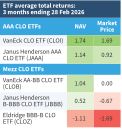
However, CLO ETFs demonstrated some resilience. Janus Henderson’s USD 27bn AAA CLO ETF (JAAA) has performed as expected, Shill said, despite some market dips.
“As the CLO market widens, we’re going to see NAV and the share price decrease because that’s a reflection on what’s happening in the underlying assets market,” she said.
“You did see moments, especially on the days when we had more selling, where there was a disconnect or a drawdown from the last share price versus now.” She puts this down to a lag in market reporting.
JAAA’s NAV was up by 1.14% in the three months to the end of February, while market price was up by 0.92%. Meanwhile, by the end of February 2026, two of the largest BBB-focused CLO ETFs — Eldridge’s CLOZ and Janus Henderson’s JBBB — were both trading under market price.
Laila Kollmorgen, managing director and portfolio manager of CLO tranches for PineBridge Investments, says she has seen consistent selling in the secondary market from “underperforming” mezz tranches of triple B and lower since the start of the year.
“If you create a product that’s going to be very volatile... and you’re focusing only on the most volatile tranches, you’re going to get it,” says Kollmorgen. “So yes, there have been outflows out of the triple B and lower CLO ETFs. The triple B tranche is the fulcrum, higher volatility tranche.
“As you get further down, your leverage increases and you have higher volatility in those tranches. What we have seen is that triple B and lower rated tranches have been widening in spread for several months now.”
Expect near-term tightening
The triple A CLO ETF opportunity window may soon close. Shill, Craig and Kollmorgen all predict near-term tightening in the underlying markets.
Japanese investors have been less involved in primary market transactions since the start of this year, favouring other asset classes. According to PineBridge analysis, Japanese investors represent around 17% of the US triple A CLO market, and their return will have an impact.
“When the Japanese bid in the market and they’re buying, you will see spreads go tighter,” Kollmorgen said.
Furthermore, the rising popularity of the relatively stable European CLO ETF market could give US-facing investors another option, particularly if US market volatility continues to weigh on portfolios.
“I think the ETF market is going to grow quite substantially from here,” said Craig. “There’s substantial growth here in Europe. I don’t expect to see enormous volatility.”
