




Listen to the latest episode of Credit Exchange with Lisa Lee
Published in London & New York
10 Queen Street Place, London
1345 Avenue of the Americas, New York
Creditflux is an
company
© Creditflux Ltd 2026. All rights reserved. Available by subscription only.


Data Secondary
CLO secondary dynamics
January trading activity suggested a market that is stabilising rather than accelerating, with consistent liquidity, tighter spreads, and improving sentiment across the capital structure
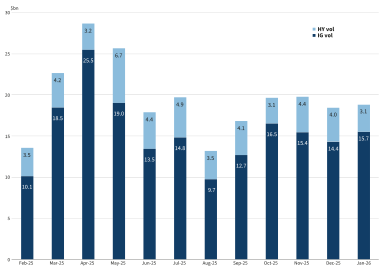
TRACE volumes flat at $18.8bn
Total TRACE trading volumes finished January at USD 18.8bn, broadly in line with December and slightly below the elevated levels recorded in November.
Liquidity remained stable through the month, with 10 trading sessions exceeding USD 1bn, underscoring continued dealer and investor engagement despite an early January slowdown.
Past 12 months FINRA TRACE monthly reported CLO/CDO volumes
Traded BWICs vs TRACE reported volume
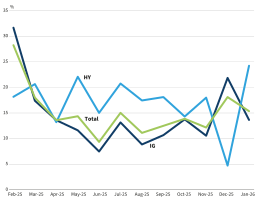
Investors lean further down capital structure
Risk appetite continued to migrate lower in the CLO stack. High-yield tranches accounted for 24% of total TRACE volume in January, up from late-2025 levels, while investment-grade participation fell to 13%.
The shift reflects growing comfort with mezzanine risk following the spread widening experienced in the fourth quarter.
Compared with November’s heavy equity supply and December’s spread volatility, January marked a return to more orderly market conditions. Tighter spreads, steadier dealer positioning, and continued liquidity point to a CLO market that has entered 2026 on firm footing.
While issuance remains disciplined and credit risks in the underlying loan market persist, January’s performance suggests investors are increasingly comfortable re-engaging with risk — albeit in a measured and selective manner.
Triple A liquidity holds even as supply moderates
While triple A BWIC activity declined month-over-month, it remained above the long-term average, suggesting that top-of-the-stack liquidity continues to function smoothly.
Execution levels were strong, with nearly 60% of posted triple A BWICs trading, a sign that demand remains intact even as sellers grow more measured.
US traded CLO BWIC volumes
US CLO new issue spreads
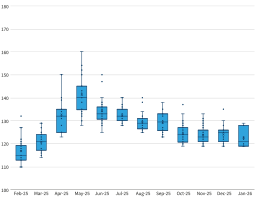
Spreads reverse after year-end volatility
Perhaps the clearest signal of January’s improved tone came from spread performance.
US BSL triple A spreads tightened to 121bps, narrowing by 4bps from December and approaching the cycle tights of 119bps. Lower in the capital structure, the triple/double B spread range tightened to 236bps from 261bps, reversing a portion of the fourth-quarter risk repricing.
At the same time, the basis between US middle-market and broadly syndicated loan triple A tranches narrowed to 19bps, indicating renewed confidence.
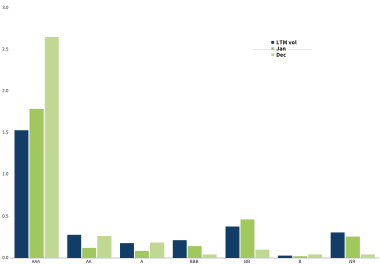
US equity traded: 2024 vs 2025 vs 2026
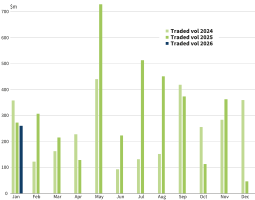
Equity trading normalises after late-2025 surge
CLO equity trading volumes were back up to USD 270m, normalising from the end-of -year decrease. This volume is in line with historical norms.

For further information, contact Jacob Krayn, head of business development, Kopentech: Jacob.Krayn@kopentech.com
Source for all data: Kopentech, TRACE
