




Listen to the latest episode of Credit Exchange with Lisa Lee
Published in London & New York
10 Queen Street Place, London
1345 Avenue of the Americas, New York
Creditflux is an
company
© Creditflux Ltd 2026. All rights reserved. Available by subscription only.


Analysis Private credit
Direct lending: a history of resilience
by Ben Watson, Debtwire
They said defaults would get it, then redemptions, then fraud, AI and redemptions (again!). But direct lending has been with us for over a decade — and it keeps proving its staying power
“Covid-era leverage will ravage direct lending borrowers”
This was one of the first arguments to predict defaults would be the greatest source of trouble for the asset class. Immediate defaults, however, remained relatively contained, even if the longer tail of that stress did later feed into a material rise in defaults as higher rates began to bite.
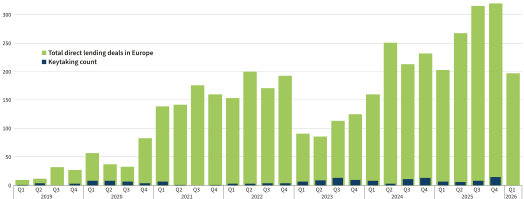
Debtwire data shows debt-for-equity swaps remained relatively low in the period following the pandemic, before rising in 2023. Debtwire recorded 32 such swaps in Europe in 2025.
1: Keytakings remain a small percentage of direct lending deals
Source for all data: Debtwire
“Rising interest rates will cripple companies, forcing swathes of direct lenders to take the keys”
High interest rates did lead to an increased number of restructurings and a growing number of lender takeovers over the past few years, but nothing like the wholesale transfer of ownership that many had predicted.
Debtwire has tracked 110 European keytakings since 2023, versus over 2,500 new deals inked (see chart 1). This equates to a 4.3% rate. In the US, the Cliffwater Direct Lending Index estimates historic realised losses of BDCs at around 1%. In some cases, structures such as PIK financing have helped borrowers navigate periods of volatility and bought time for lenders and sponsors to work through stress.
4.3
%
Percentage of keytakings in 2,500 European deals tracked by Debtwire
“Returning stability and tightening margins will mean lenders will refinance with cheaper public debt”
In some cases, this prediction was correct. In others, the reverse proved true. A notable number of borrowers with access to public debt markets have refinanced into direct lending, drawn by certainty of execution, speed, structural flexibility and, in many cases, the ability to secure higher leverage.
Recent live situations underscore the point. At the time of writing, SLV Lighting’s most likely route will be to refinance the majority of its existing term loan B with a direct lending loan, even while pricing in the syndicated loan market remains at record tights. Alanta Health is also in discussions to refinance its EUR 300m public loan with private credit financing, as reported by Debtwire last month.
Direct lending issuance
2: Software firms issuance by volume
3: Global direct lending volume
18.4
%
Software firms’ proportion of total 1Q26 issuance by volume
62
%
Percentage of 1Q26 European deal volume due to large cap borrowers
4: Large cap borrowers dominate by volume
5: Refinancing remains dominant into 2026
“Where you see one cockroach, there are surely others”
So far, clear instances of fraud remain largely idiosyncratic rather than evidence of a systemic pattern in core direct lending. Defaults are a feature of the leveraged market, and the high returns gained from lending this capital are in large part due to this risk. While lessons can be learned from these cases, and underwriting can be improved to steer away from them, they do not amount to evidence of a systemic dysfunction in core direct lending.
“Direct lenders are overexposed to software and the SaaS-pocalypse will see many wiped out”
Direct lending is certainly overexposed relative to public leveraged capital markets, and fears surrounding the impact of AI on existing business models have raised fresh questions over underwriting standards and portfolio concentration. Yet the picture is not binary. Many of these companies operate on multi-year customer contracts, giving management teams time to adapt and lenders time to manage potential losses rather than absorb them all at once.
Chart 2 shows software as a proportion of total direct lending. However, it is somewhat misleading. Treating software as a single risk bucket is too simplistic. Some providers will be disrupted by the effects of AI, while others will materially benefit from its adoption.
“Who would invest in direct lending now that all new capital will go towards funding redemptions?”
This recent concern appears overstated. Redemption pressures are concentrated largely in semi-liquid US retail vehicles rather than across the direct lending market as a whole. Players in Europe are reportedly continuing to see inflows into funds, while reduced competitive intensity has in some cases begun to improve deal terms.
Direct lending’s growth is ongoing
Against the backdrop of redemptions and doom-mongers, direct lending has continued to grow. Despite repeated warnings and periodic bouts of pessimism, it has cemented its place as a core source of leveraged finance capital. Although transaction numbers in 1Q26 fell to one of the lowest figures in the past two years, quarterly volume still reached USD 121bn — the highest first quarter on record and the fifth-highest quarterly total overall (see chart 3).
Debtwire data points to several dynamics underpinning this resilience. Large-cap borrowers remain an important driver of activity, accounting for 62% of total volume in 1Q26 (see chart 4). However, the market has gradually shifted back towards the mid-market and lower mid-market in recent years.
Refinancing has also become an increasingly prominent theme, representing 26% of global activity by volume. New-money issuance, led by LBO financings, has remained close to the strongest levels seen over the past year (see chart 5). The growing share of refinancings reflects the increasing prevalence of that deal type rather than a retreat in fresh capital deployment.
Sponsor-backed deals, meanwhile, continue to dominate direct lending, accounting for 60% of volume so far in 2026. That trend is consistent with the broader migration of buyout financing towards direct lending and away from public syndication in recent years.
Once again, direct lending is showing resilience. Pipelines may be shifting away from software, but market participants say incoming opportunities are already beginning to return, with many lenders looking ahead to a productive second half of 2026.
