




Listen to the latest episode of Credit Exchange with Lisa Lee
Published in London & New York
10 Queen Street Place, London
1345 Avenue of the Americas, New York
Creditflux is an
company
© Creditflux Ltd 2026. All rights reserved. Available by subscription only.


Analysis Hybrid credit
Gearing up private credit CLOs in Europe
by Kathryn Gaw & Shant Fabricatorian
Hybrid deals are the latest attempt to make private credit CLOs work in Europe. They aim to combine private credit and leveraged loans to create a vehicle that delivers yield and liquidity
When the first private credit CLO hit the European market in late 2024, hopes rose that a new asset class would soon develop. But nearly two years on, growth has been slow, prompting managers to experiment with variations that might get deals going.
The latest iteration in the lab is what the market so far has dubbed a ‘hybrid CLO’. It mixes private credit and broadly syndicated loans (BSL). Managers are betting these deals will be the next evolution of the asset class — but others say they demonstrate the immense difficulty of issuing pure private credit deals on the continent.
Blackstone and Sona Asset Management are among the firms known to be working on these new structures, with at least four hybrid deals believed to be in the works at present, according to market sources. If the first batch of issues go well, other firms are waiting in the wings.
Private credit CLOs: US vs Europe
Tailored to meet investor needs
“We expect it to be a growth area as managers seek to differentiate themselves from the competition and tailor their franchises to meet investor needs and evolving investor demand dynamics,” says Noeleen Ruddy, a partner at law firm Walkers. “By mixing these assets, managers can aim to balance the high liquidity of BSLs with the higher yield and customised terms of private credit assets.”
According to a variety of market sources, hybrid vehicles are a direct response to the slow growth of the European PC CLO market.
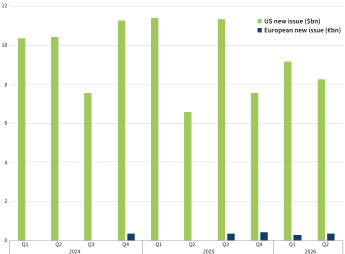
Barings issued the first European PC CLO in the autumn of 2024, raising the prospect that they had cracked the code for the region, yet only four deals have followed. Worse yet, only two other managers — Ares and Golub — have issued a PC CLO to date. The cumulative value of these deals totals just over EUR 1.7bn.
In sharp contrast, the US has a robust PC CLO market. Over the same period, US managers priced more than USD 65.5bn in new PC CLOs. In the US, PC CLOs represent just over 20% of the overall CLO market, according to Creditflux data.
Managers can aim for balance
Noeleen Ruddy
Partner
Walkers
Europe’s struggle hasn’t been for lack of trying. Managers have trialled various innovations to get new deals done. Across the five deals priced to date, there have been seen static, reinvesting and multi-currency prints, as well as structural innovations, such as the optional inclusion of a BSL sleeve.
Now, hybrid deals are coming to the market in an effort to meet demand for private credit products, by combining PC and BSL loans. This is the first time this kind of structure has been tried on either side of the Atlantic. If successful, these hybrids could transform the European PC CLO market and deliver a new route for investors to access a more robust pipeline of private credit opportunities on the continent.
The first European PC CLO arrived in October 2024 as a static euro issue from Barings, which is expected to be reset as a reinvesting multi-currency deal. At the time, there was an expectation that the European market was gearing up to compete with the robust US PC CLO space, but almost two years on, the limitations of the European market are becoming hard to ignore. So far this year, macroeconomic volatility has wreaked havoc with origination and valuations, heaping pressure on managers and delaying at least one expected new issue.
US has club-style lending
For Joe Evanchick, head of the middle market CLO platform at Barings, the slow growth of the European PC CLO market is due to the lack of diversified PC portfolios. “The European PC lending market typically has one lender, versus a club-style lending group in the US,” he says. “This means the larger managers that can speak for an entire facility will have an advantage over others.”
With this in mind, it is easy to see how the hybrid structure would appeal to those European managers searching for an entry point into the space. According to market sources, around four managers are currently exploring hybrid issuance, while Creditflux is aware of at least one other manager — currently working on a debut PC CLO — which has described a hybrid deal as “not off the table”.
The key benefit of the hybrid model is diversification. Sources have told Creditflux that the structure of these hybrids is designed to be flexible, but that the deals start with a majority of BSL loans and a minority of PC loans within any given portfolio. The PC proportion is designed to increase over time, potentially over the duration of the deal’s reinvestment period.
“From a structural standpoint, I think they resemble private credit deals while allowing for a portion of assets to be acquired from the BSL market,” says Nick Shiren, a partner at Hogan Lovells Cadwalader. “From the manager’s point of view, it gets the deal up and running quickly. We are hearing that investors want diversification.”
European private credit CLO issuance
One market source said that the hybrid structure could be thought about as an extended warehouse, and more particularly, an extended, rated CLO warehouse. In this framing, the BSL component serves primarily as a ‘cash park’, intended to avoid negative carry. The source noted that when a manager is ready to originate, they can start substituting one asset for the other.
While some contend that it is difficult to see the benefits of a hybrid arrangement over simply raising a private credit fund and drawing a private credit CLO from that fund, this market source noted that the use of CLO technology could bring benefits. For example, substituting with BSL collateral allows for a good implied spread and also provides a liquid loan — offering advantages in selling and transferring out of the market.
However, not everyone is on board with the idea that hybrids represent the future of the European PC CLO market. One prominent CLO manager dismissed the idea that hybrids represent a growing trend, noting that every European PC CLO priced to date has included the option to include BSL exposure via a separate sleeve. For example, the recent Golub transaction included the ability to purchase BSL loans, with an allowance of up to 20% of the reinvesting portfolio, although this allowance had not been utilised at the time of writing.
The key difference between PC CLOs with BSL sleeves and true hybrids is that the hybrid deals include both types of loans from day one, albeit in varying ratios. The BSL portion of the PC CLOs priced to date exists at the managers’ discretion, to provide additional flexibility when needed. By contrast, hybrid deals are designed to include both types of loans at all times.
BSLs increase diversification
Joe Evanchick
Head of middle market CLOs
Barings
“Traditionally, PC CLO managers in the US have added BSLs to increase diversification and aid in the ramp of those portfolios,” says Evanchick. “Given the dynamics of the European PC market, where it’s more difficult to aggregate a diversified PC portfolio, it’s logical that a PC manager would combine BSLs and PC.”
Evanchick would not be drawn on whether or not Barings would consider a hybrid vehicle of its own.
Another CLO manager dismissed the need for hybrid structures and noted that investors tend to want exposure to either BSL or PC. “If I was on the investor side, I’d say just keep warehousing until you get the right thing, and then I’ll go into that,” they said.
“It’s worth noting that even in those instances whereby European managers may include BSL loans in their middle market CLOs, it tends to be a modest proportion because investors allocate to these instruments in pursuit of middle market private credit — not BSL — exposure,” they added. “Investors seeking BSL exposure can simply allocate to BSL CLOs outright.”
Until the first hybrid deals are priced, it will be hard to know how managers, ratings agencies, lawyers and arrangers plan to navigate the unique risks that come with doing a first-of-its-kind deal. There is already a flurry of activity behind the scenes, as experts work to iron out structural issues and ramp new deals in a challenging macro environment.
