




Listen to the latest episode of Credit Exchange with Lisa Lee
Published in London & New York
10 Queen Street Place, London
1345 Avenue of the Americas, New York
Creditflux is an
company
© Creditflux Ltd 2026. All rights reserved. Available by subscription only.


Analysis Private credit CLOs
Finding the upside in private credit CLOs
by Kathryn Gaw, Shant Fabricatorian & Lisa Fu
Compared to the first quarter of 2025, the opening months of 2026 have been tough. Managers are still issuing private credit CLOs, but the timing has to be right as the macro backdrop shifts
After record issuance in 2025, this year was expected to see further robust growth for US private credit CLOs. But by the end of the first quarter, a new narrative was forming.
Amid a succession of negative headlines about private credit illiquidity and default risk, and against the backdrop of macroeconomic and geopolitical uncertainty, private credit CLO investors and managers are now recalibrating their expectations and preparing for a slowdown in issuance.
“Investors have become increasingly selective, with greater emphasis on portfolio quality and manager performance,” says Seth Painter, head of capital solutions at Antares Capital. “This dynamic has extended execution timelines and may result in total CLO issuance in 2026 falling short of earlier market forecasts.”
2025-26 US private credit CLO issuance per month
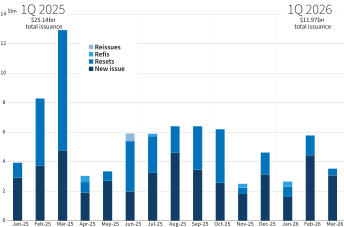
Source for all data: Creditflux
First quarter issuance has halved
At the start of the year the market was preparing for a boom in leveraged buyout (LBO) activity, which would fuel direct lending volumes and accelerate private credit CLO issuance. Instead, issuance has halved for the first quarter, year-over-year. Meanwhile, triple A spreads widened by approximately 30bps between the end of January and the end of March, doubling the spread differential between private credit and US BSL CLOs.
“The macro backdrop has had an impact on all credits, and the perception of small obligors being less resilient than bigger companies has impacted sentiment towards private credit CLOs and their creation more than their BSL counterparts,” says Michael Boyle, a partner and portfolio manager in Bain Capital’s Private Credit Group.
Private credit CLOs differ from BSL in that the underlying loans are directly originated by the lender, allowing for bespoke portfolio construction and potentially higher yields. However, liquidity is limited and there is little transparency outside of investor reports.


You could wait for this to dissipate
Kelli Marti
Head of CLO management
Churchill Asset Management
Over the past decade, private credit CLOs have been gradually building up their market share in the US. In 2015, new private credit CLO issuance represented just 6.15% of all new US CLO issuance, according to Creditflux data. By last year, that proportion had tripled to around 18.5%.
These vehicles have become an increasingly important source of refinancing for US businesses, and a key diversification tool for investors. But in recent months, the asset class has been tarnished by its association with private credit funds, which have been plagued by concerns around their exposure to the beleaguered software sector, leading to a flood of redemption requests.
“I think generally, we feel like it’s an environment of caution. Investors aren’t quite sure where credit spreads will settle,” says Jerry DeVito, head of credit finance and capital markets at Blue Owl. “We think the amount of cash out there to deploy is still pretty high, particularly from the insurance investor community. But it’s still early in the year. And people don’t want to be investing if they think they may see additional spread widening if they wait a month.”
Blue Owl printed its most recent private credit CLO — Owl Rock CLO XXIV — at the end of January, with triple As priced at 139bps over SOFR. Since then, triple A spreads have widened significantly. On 27 March, Diameter’s second private credit CLO issuance of the year priced its triple As at 170bps over SOFR.
“Deals are still getting done,” says Boyle. “The market is back in price discovery mode and it provides the opportunity for strong managers to differentiate themselves.”
Private credit CLO total issuance by manager ($bn)
A chance to lock in higher rates
The uncertainty in the market has sparked a range of reactions from managers. While some are holding back and waiting for stability to return, others are taking advantage of what they see as a unique opportunity to demonstrate their skill and lock in higher rates for their investors.
“Many of the frequent private credit CLO issuers are probably also looking to tap the market, but it may take a while to get deals done in the near-term,” says Victoria Chant, global head of capital markets and bank relations at Blackstone. “One issue is the market uncertainty for investors, but some investors may already have concentration in those managers that issued frequently last year.”
Blackstone priced its first static private credit CLO of the year towards the end of March, with triple As at 128bps above SOFR.
“There was a need for the capital,” Chant says. “My view is that an investor has a much easier time in this market underwriting a static portfolio of assets rather than something when there’s a new headline coming out every day.”
Concentration in frequent issuers may be an issue
Victoria Chant
Global head of capital markets
Blackstone
Blackstone is keeping an eye on how triple A investor banks are behaving regionally. When there are questions about underwriting at banks, they usually look at what they have been doing with CLO books. The firm has noticed some slowing with triple A capital, but it has not stopped yet.
By contrast, Blue Owl’s DeVito says his team is happy to sit and wait, although he adds that the firm has been using CLOs as a financing tool for its BDCs as far back as 2019. “I think some of our peer group may have been less reliant on CLOs,” he adds.
At the SFVegas conference in February, Chant says investors indicated they were looking for short-duration credit. According to market sources, investors are trying to assess both their private credit and liquid credit exposures as they regroup due to AI risk in their portfolios.
Rapid advancements in AI have seen some software businesses plummet in value. According to S&P Global data, at least 25% of US private credit CLOs are directly exposed to software and AI dynamics, compared with around 7.5% in Europe.
Private credit CLO new issuance by manager ($bn)
Source for all data: Creditflux
Spiking triple C tranches
“I would argue, in the US, that vulnerability and exuberance in confidence when it comes to AI will cause pain,” says Marta Stojanova, director of leveraged finance at S&P Global Ratings, at a media briefing in late March. She adds that there has been a spike in CCC+ tranches in US private credit CLOs, which have more than doubled from two years ago.
Yet despite worries about AI contagion, the underlying assets continue to demonstrate low default rates, while investor demand remains. Kelli Marti, head of CLO management at Churchill Asset Management, believes that pricing for private credit CLOs is unlikely to widen further. She says asset managers have two options in the present environment — price into that widening environment, or take a pause.
“If you think this widening is temporary and things are going to go back… you would absolutely wait for this to dissipate and then go to market,” she says. Churchill is planning a new issue later in the year and another reset or two, dependent on the market.
However, ‘wait and see’ managers may risk losing momentum in a competitive market. Private credit CLOs require the manager to originate each individual asset, and it can take up to 18 months to fully ramp a deal. There are also concerns about the availability of bank support. There have been rumours that some banks are pulling back from providing leverage to private credit firms, although this is not believed to have impacted the private credit CLO market to date.
Antares’ Painter notes that banks have become more selective and are applying greater scrutiny to the managers they support. “This has resulted in increased emphasis on sponsorship quality, capital alignment, track record and demonstrated workout capabilities,” he says.
Painter has noticed that investors are becoming more selective and focusing on factors such as the stability of the capital backing a franchise, along with experience, workout capabilities and transparency.
But private credit CLO managers still have plenty of financing options, and many appear to be comfortable waiting out market volatility for a little while longer. “We can do private bank facilities that are structured like CLOs; we can do unsecured debt; we have other types of bank facilities,” says DeVito. “We view CLOs as our lowest cost funding option. And a lot of the other products, other than unsecured debt, will price off where the CLO market is. So we don’t have a desire to issue into a volatile market if we think it’s going to stabilise.”
Private credit still open for business
Even with a pause in issuance, private credit CLOs will continue to maintain their market share. Businesses still require financing, even if the cost of funding is rising. According to S&P’s Stojanova, around 70% of private equity M&A activity last year was funded by private credit rather than BSL, and the channel remains open.
“We continue to see activity across the core middle market,” says Bain’s Boyle. “Sponsors are still actively preparing companies for sale, and are very active identifying companies seeking institutional capital for the first time.”
Despite a slow start to 2026, there is still plenty of activity behind the scenes, and the sense is that once the software panic dies down, and the geopolitical environment becomes clear, a wave of deals will hit the market. “The expectation is that private credit CLOs will continue to represent a larger percentage of the CLO universe when compared historically,” says Eric Hudson, co-head of global structured credit at KBRA. “I do think it will be probably in line with what we’ve seen last year.”
2015-25 US private credit CLO issuance per year
US private credit: new issue triple A CLO spreads
New in private credit CLOs: Kohlberg & Co
Why is Kohlberg interested in private credit CLOs?
AS: Kohlberg has been a middle-market private equity manager for almost four decades.
When I joined, the idea was to leverage the expertise that we have within the two broad sectors that we focus on, which are services and healthcare, to build out a credit platform.

The idea was to leverage our expertise in services and healthcare
Albert Scheer
Partner, credit & capital markets
Kohlberg & Co
When did you start thinking about issuance?
AS: Around 2020 we started building out the team in earnest, with an eye toward creating a diversified portfolio of middle-market credit. As we scaled, we have found our strategy to be naturally aligned with the structuring and ratings requirements of middle-market CLOs, as well as the desires and needs of the underlying investors in those CLOs.
Kohlberg had previously managed other financing facilities within our credit platform — ABLs and hybrid financing facilities — and also had a private CLO that we set up. All of those facilities, particularly the private CLO, had structuring and ratings requirements similar to a more traditional middle-market CLO, giving us significant insight into what we would need.
What did you find more difficult than expected?
AS: Our first two CLOs are European risk-retention compliant. There are certainly some complexities with that, but we thought it important to ensure each of these financings was eligible for European investors.
Most recently, while we were on our second CLO, there’s been a lot of noise in the market around software and tech, and the impact of AI. I think we’re fortunate in that Kohlberg as a firm has not invested historically in software or tech. I think it has really positioned us well.
