




Listen to the latest episode of Credit Exchange with Lisa Lee
Published in London & New York
10 Queen Street Place, London
1345 Avenue of the Americas, New York
Creditflux is an
company
© Creditflux Ltd 2026. All rights reserved. Available by subscription only.


Analysis Sponsored by Entegra
Phantom Premium - Part 1: Why AAA CLO spreads reflect liquidity perception rather than credit risk
by Daniel Ezra, Founder & CEO, Entegra
AAA CLO spreads have carried a persistent spread premium to corporate IG since the GFC. You see it clearly versus a liquid gauge like CDX.IG, which many participants use as a hedge for CLO AAAs and a yardstick for spread performance. The standard explanation for this premium is familiar: credit risk, complexity, and a narrower buyer base. But recent evidence challenges that story, especially once you look at liquidity through what the market observes day to day. If the premium is not primarily credit, then what is the market pricing, and what would make it converge?
1: Persistent Spread Premium of AAA CLOs vs IG Corporates
AAA CLOs have cleared on average at ~2.5x CDX.IG spreads despite a higher rating and lower historical loss
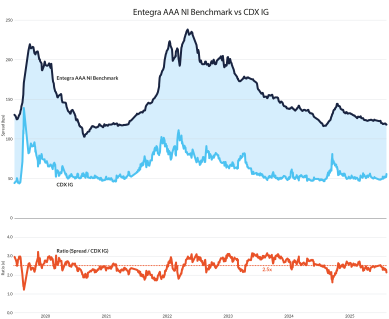
According to Moody’s, AAA CLOs have exhibited a zero default history since 19931, making it harder to sustain credit risk as the primary explanation for their persistent premium. In addition, CDX.IG carries an average rating of ‘A’, which would suggest it should trade wider than senior CLO debt, not tighter. Structural complexity is also less convincing, particularly at the AAA level, as post-GFC scrutiny has made the asset class far better understood than it once was. The buyer base has meanwhile broadened materially. Banks and insurance companies that dominate investment grade corporates are also among the largest buyers of AAA CLOs, while ETF vehicles across AAA and mezz, now totaling over $40 billion, have expanded access to retail investors.
Recent market commentary has also reinforced that senior CLOs can trade in size, including during periods of stress. That is not to say CLOs are riskless. They carry structural features and exposure to leveraged loans that differ from corporates. The question is whether those differences are sufficient to explain a spread relationship that has remained both wide and stable over time. If not, the explanation may lie less in the assets themselves than in how the market trades them.
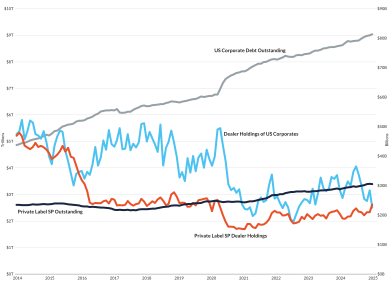
2: Outstanding SP & Corp vs Dealer Holdings of Each
Dealer holdings are broadly similar in dollar terms across corporates and private label SP
To assess where this premium is actually being priced, we compare Entegra’s new issue AAA CLO benchmark, grounded in primary market prints, with CDX.IG as an apples-to-apples measure of where risk actually clears. As shown in Chart 1, AAA CLOs clear near 125 basis points versus roughly 62 for IG corporates, a gap that has remained broadly consistent at ~2.5x over time. If credit risk does not explain the gap, and structural complexity explains only a small portion, the remaining spread suggests the driver lies elsewhere in the market, particularly in how prices are formed and observed.
A natural place to look is dealer balance sheet capacity. Chart 2 compares market size with dealer holdings across private label securitized products (SP) and corporate credit, but the relative scale makes it difficult to treat balance sheet as the primary constraint. The US corporate bond market is close to $10 trillion, with dealers holding about $30 billion, compared with roughly $3.5 trillion for SP, where dealer holdings are about $25 billion. Dealer holdings are broadly similar in absolute terms, and larger as a share of the securitized market. If balance sheet were the binding constraint, SP should trade tighter, not wider. The persistence of the premium is therefore not explained by the quantity of balance sheet.
What looks like a liquidity premium is, in practice, a visibility premium
Daniel Ezra
Founder & CEO, Entegra
If dealer balance sheet is not the explanation, the next place to look is turnover. Chart 3 suggests the real distinction may lie here. Corporate credit has become more actively traded over time, while SP have moved in the opposite direction, leaving fewer observable pricing points relative to the size of the market. This gap doesn’t create stress, but it does mean each incremental dollar of supply is supported by less visible liquidity than the one before it. It may also be the first real clue to why the spread premium persists.
A common explanation is that too much of the market is held by buy and hold investors. But that does not fully explain the data. As of year-end 2024, banks and insurers owned about 43% of the private label SP market, leaving 57% in other hands — enough to support healthier trading, yet turnover continues to stagnate. Ownership structure may explain part of the slowdown, but not its scale. Even where a meaningful share of the market sits outside traditional buy and hold balance sheets, trading activity does not emerge proportionally. That suggests turnover is not simply a function of who owns the assets, but of how the market supports their trading.
In that case, the issue may not be the presence of liquidity, but how visible and repeatable that liquidity is in practice. Table 1 measures Daily Quote Penetration: the percentage of the annual quoted universe that is quoted on an average day. In corporate credit and leveraged loans, this is measured at the issuer level. For CLOs, to keep the comparison like for like, we measure it at the deal level (rather than by tranche or CUSIP). On that basis, roughly 60% of corporate investment grade, high yield, and leveraged loan issuers are quoted on an average day, versus only about 8% of CLO deals. That gap goes to the heart of the problem. It reflects a large difference in visibility per unit of supply.
Taken together, the data reveals not just weaker turnover or lower visibility, but a deeper structural difference in how liquidity is accessed across the two markets. Corporate credit operates with continuous quoting as electronic platforms keep prices refreshed throughout the day. In SP, secondary trading is still largely intermediated through BWIC auctions, with roughly 55% to 60% of CLO TRACE volume coming through this time-consuming process. Platforms like Octaura can improve the efficiency of BWIC execution, but they do not solve the underlying issue: liquidity is still episodic rather than continuously observable. That matters because investors price not just whether they can trade, but how quickly and reliably they can exit. When visibility is intermittent, perceived liquidity weakens, and that uncertainty becomes embedded in spreads.
3: Trading Turnover in Corporates and SP
Corporate turnover has increased while private label SP turnover has declined
The cost is not just wider spreads, but less efficient financing and a narrower buyer base. Investment grade corporates typically finance at repo rates in the 20 to 30 bps range, with haircuts of roughly 3% to 5%, while AAA CLOs finance closer to 60 to 75 bps with haircuts of 7% to 10%. That gap reflects how reliably collateral can be observed, financed, and liquidated. As a result, systematic and macro investors, which rely on assets that are continuously priced and efficiently financed, are structurally underrepresented. Their limited presence in CLOs is not incidental, but a direct consequence of how the market functions. Rather than correcting the problem, the market has adapted around it, with capital shifting into private credit as a symptom of weakening public market liquidity, not a cure.
This dynamic can be framed as a simple capital flow chain: visibility drives accessibility and accessibility drives liquidity. In the CLO market, the constraint sits at the first step, visibility. Dealer capacity did not keep pace with growth, turnover declined, and liquidity became increasingly episodic rather than continuously observable.
That is why AAA CLO spreads are not fully explained by structural complexity or credit risk. What looks like a liquidity premium is, in practice, a visibility premium. As the market grows without a corresponding increase in continuous, observable pricing, that gap becomes less a feature of the asset class and more a reflection of a market structure that does not scale cleanly with size. Until securitzed products can offer the same speed and reliability of execution as corporate credit, the spread gap between AAA CLOs and their benchmark is unlikely to compress meaningfully.
1 Moody’s Data Report, 23 June 2025 - Impairment and loss rates of global CLOs: 1993-2024
From Episodic Liquidity to Continuous Visibility
Entegra is designed to address the structural gap between credit quality and perceived liquidity in securitized products.
By embedding its Trading as a Service (TaaS) model at partner banks, it focuses on improving visibility by facilitating daily observable markets without requiring additional dealer balance sheet. The model is intended to:
- Increase the frequency of actionable pricing (daily)
- Improve certainty and speed of trade execution
- Reduce reliance on BWIC driven liquidity
Over time, greater visibility will support broader accessibility, deeper liquidity, and tighter spreads.
For more information, please contact info@entegra-global.com or visit www.entegra-global.com.
