




Listen to the latest episode of Credit Exchange with Lisa Lee
Published in London & New York
10 Queen Street Place, London
1345 Avenue of the Americas, New York
Creditflux is an
company
© Creditflux Ltd 2026. All rights reserved. Available by subscription only.


Profile Sound Point Capital
The right moment to take a chance
by Lisa Lee & Kathryn Gaw
Stephen Ketchum founded Sound Point during the global financial crisis with seed funding of USD 35m. He moved into CLOs in 2012. Today, the firm has many arms and AUM of USD 46bn
Stephen Ketchum has been in this business long enough to know when it’s a good time to take a risk, and when to play it safe. In 2008, when the world was still reeling from the worst global financial crisis in a generation, Ketchum left a steady job running the global media and telecom business at Bank of America to set out on his own and build a credit business.
“For credit investors, this was the investing opportunity of a lifetime,” he says. “And I said to myself and to my wife, if I don’t do this now, I will look back in 30 years and say, you know what? I never tested myself. I came to the conclusion that I would give myself three years.
“In retrospect, it was a great time to start. It was unequivocally the best time to invest capital if you had it. It was also unequivocally the worst time to raise capital because everybody was scared and everybody had lost money.”
Partnering with Stone Point
Sound Point Capital was founded with Ketchum’s own money, with additional support coming from an old business school classmate who was running a family office. He went on to partner with the Greenwich-based equity firm Stone Point Capital, which invested in the firm’s first commingled fund. This initial fund offering was seeded with USD 35m. Today, the company’s AUM is USD 46bn.
“Sometimes I wake up in the middle of the night saying, ‘Oh my God, I can’t believe I did that because it was tiny and there was no guarantee that we were going to make it,’” says Ketchum.
Sound Point now offers a range of alternative credit strategies, from CLOs to opportunistic credit, private credit, structured credit and separately managed accounts. More recently, the firm has added a corporate credit business and a consumer credit business by virtue of its specialty finance arm, as well as a commercial real estate credit business.
“We’ve gained the trust of investors by staying true to our nature,” says Ketchum. “That’s one fundamental building block.”
The Sound Point story
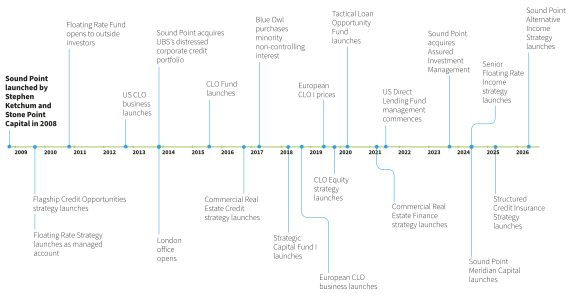
Ketchum graduated from Harvard Business School in 1990, and went on to work at Donaldson, Lufkin & Jenrette (DLJ). He spent 10 years at DLJ, when it was the number one underwriter of high yield bonds and leveraged loans, and the number one restructuring advisor. He helped people like Rupert Murdoch, the Dolan family and Charlie Ergen build their media empires. Ketchum describes his tenure at the firm as being like an MBA in leveraged finance.
When DLJ was sold to Credit Suisse, Ketchum went to UBS to work as a managing director, building out the firm’s media and telecommunications practice.
“If you think about 2001, it was the culmination of the telecom technology boom bust cycle,” he says. “We were doing so many restructurings, and I was working on a restructuring of the largest bankruptcy ever. It was a firm called NTL — now Virgin Media. It was a massive restructuring. And all the really smart distressed firms were in that deal. They were buying unsecured bonds, flipping them or exchanging them for equity and controlling the company. And I was advising the unsecured bondholders. It was the most intellectually fascinating thing I had ever done.”

It started to take off when we diversified into CLOs
This experience taught Ketchum that he wanted to do what the leveraged finance guys were doing. And after his stint at Bank of America, and the collapse of the global financial markets, that’s exactly what he did.
“If I look back at the first three years, we were moving our way to around USD 100m,” he says. “It felt like we were doing great things because we were putting up good returns and having great meetings. If we raised a million dollars, we would take everybody to dinner. It was exhilarating.
“But when it really started to take off from a standpoint of AUM growth is when we started to diversify into the CLO business.”
At the time, CLO equity tranches were yielding mid-teen returns and had performed well during the global financial crisis. Sound Point initially invested in CLO equity through its hedge fund, so Ketchum was familiar with the management space.
“I said, I’d rather manufacture this product than buy a product that I think is deficient from somebody else,” Ketchum says. “It’s also a great way to build a durable business because when you do a CLO, this is long-term, locked-in capital.”
Launching a CLO business
He went to his partners at Stone Point and delivered his initial investor pitch, before taking his CLO business plan on the road. Before long he had raised USD 50m in captive equity to do a USD 400m CLO, with JP Morgan coming on board as its first triple A investor.
“Then we were off to the races,” he says.
Since then, Sound Point has continued to expand. In 2013, Sound Point acquired UBS’s distressed practice “at a great price”, and suddenly the firm was in the distressed business. Ketchum also carved out a pocket for commercial real estate credit, bringing on a former DLJ colleague — Don MacKinnon — to build this business in-house from scratch. Today, Sound Point’s commercial real estate credit arm is worth more than USD 6bn.
In 2021, Sound Point bought a middle market lending business from CVC in response to investor demand for private credit options.
“We will create whatever structure is best for our investors,” says Ketchum. “We will bend over backwards and deliver the information that you need. That ethos and DNA is still with us today.”
This approach has worked well for Sound Point to date. The firm has almost a 10-year track record in its capital solutions business and recently closed its third vintage — Strategic Capital Fund 3 — with USD 1.5bn.
“At some point in the future, we might be able to accommodate a larger fund, but we made the decision that we didn’t want to take the risk of having to deploy USD 3bn or USD 4bn,” he says.
Some 18 years after founding Sound Point Capital, Ketchum still loves what he does. He takes pride in watching his employees develop their careers and raise their families.
“We’re proud of what we’ve done, but there’s so much more we want to do. I think it’s an edge — there are fewer and fewer founders,” Ketchum says. “I can’t imagine what I would do if I wasn’t running Sound Point. I love to play golf, but not every day.”
Market View
‘The entry point for CLO equity is super interesting now’
The last couple of years, we’ve had two separate challenges in CLO equity after several spectacular years of double-digit performance. In 2025, the challenge was spread compression. In 2023 and 2024, there was a lot of new issue creation. Then the assets, the loans that we put into those CLOs, the spreads tightened but the liabilities were stuck for two years, which impacted the return and created some mark-to-market issues. So now 2026 arrives, we’re able to refinance a lot of those capital structures and open that spread back up.
We’ve re-diligenced all these companies
Stephen Ketchum
Founder & CIO
Sound Point Capital Management
Then what happens? Well, the SaaSpocalypse happens. Now there’s much more price discovery where we and other CLO managers are saying, we’ve re-diligenced all these companies, and here are the companies that we think will survive and thrive in this new era of AI, and here are the software companies that we think will struggle.
There’s been a lot of re-jigging portfolios. The market, broadly speaking, is saying, look, there’ll be plenty of survivors and there will be some software companies that will harness AI and actually increase their profit margins.
First we had the spread compression issue, then the SaaSpocalypse issue. To me, the entry point for CLO equity is super interesting now. This is an opportunity to take advantage of entry points for CLO equity because those two issues, those two back-to-back issues, have subsided.
We’re really interested in poking around and finding things in secondary. But I believe that this vintage, the second half 2026 vintage, will be interesting on the new issue side as well.
