




Listen to the latest episode of Credit Exchange with Lisa Lee
Published in London & New York
10 Queen Street Place, London
1345 Avenue of the Americas, New York
Creditflux is an
company
© Creditflux Ltd 2026. All rights reserved. Available by subscription only.


News Analysis
Investors push rebound in quality software credits
by Lisa Fu & Lisa Lee
Credit markets are sanguine in the face of geopolitical and macro-economic disruptions, as investors shrug off the possibility that a prolonged war in the Middle East will send energy prices soaring and global economies tumbling into recession.
“The markets are still functioning. Deals are getting done,” said Cade Thompson, partner, global co-head of debt capital markets at KKR.
M&A transactions, the lifeblood for new debt supply, are being inked. Leveraged loan deals are being sold in bulk. CLOs are being printed at pace.
“There’s still a tremendous amount of liquidity in the system. Even going back to COVID, there was a couple of trillion dollars of stimulus that came in, that really hasn’t been taken out yet. Folks do have to deploy,” said Matt Laurino, a managing director at private credit behemoth Blue Owl.
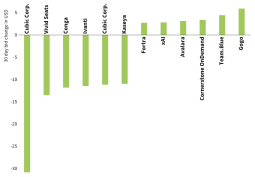
Biggest BSL movers in IT and software sector tracked by Octaura
Widening is not extreme
Despite the tumultuous backdrop, which portends the return of higher inflation and has already prompted central banks around the globe to halt interest rate cuts, credit spreads have widened just a touch. In the US CLO market, tier-1 triple As have widened by around 10bps from their tight earlier in the year of around 115bps over SOFR.
“While some CLO liabilities widened, you still saw deals getting done because of where managers were able to source loans,” said Matt Maxwell, head of US leveraged loans at Carlyle. “A sophisticated CLO investor universe exists that is able to price the risk across the CLO stack even in volatile markets. So there continues to be strong investor demand from CLO tranche investors.”
The leveraged loan market saw more than USD 30.2bn of deals priced during the week ending 27 March, and more than USD 20.9bn were announced, a steady climb from the past few weeks, according to Dealogic data.
Banks led by JPMorgan easily sold a giant debt package to back the USD 55bn buyout of video game giant Electronic Arts, even upsizing the loan component of the deal and tightening pricing on the downsized bond tranches due to robust investor demand, Debtwire reported.

We see larger cap structures outperform smaller names
Howard Cohen
Head of markets
Octaura
But not every deal flew off the shelf. Banks led by JPMorgan Chase decided to hold off syndicating the debt for Qualtrics’ acquisition of Press Ganey Forsta as the software developer’s existing loan declined in the secondary markets.
“What investors are looking for right now is high credit quality and easy to understand names,” said Thompson.
Beyond the Iran war, artificial intelligence still reigns as the bogeyman in leveraged loans, say sources. But movement in secondary loan prices over the past month indicates that investors are starting to separate potential winners from losers in software and technology.
“If you went back [to the beginning of March], software loans were in a far worse place than they are today,” said Aly Hirji, head of European credit and portfolio manager at Elmwood Asset Management.
Over the past 30 days or so, clients on the Octaura loan trading platform have started to align on which loans are worth chasing and which loans to sell off, observed Howard Cohen, head of markets at Octaura.
“There are ‘haves’ and ‘have-nots’ in software,” Cohen said. “Higher-quality names are down marginally relative to some lower-rated names. We’ve also seen larger cap structures outperform smaller names.”
A little over half of the 121 credits in the information technology and software sector tracked by Octaura saw 30-day bids decline, according to data as of 24 March. On the other hand, around 40% saw an increase in their 30-day bid price. In this data set, Gogo saw the largest interest with its bid price increasing by USD 5.96. Cubic Corporation experienced the largest loss. Its 30-day bid price declined by USD 30.84.
Some small names in the software and technology sector suffered most. Because they don’t have many holders, it only takes a couple of transactions for them to move down multiple points, said Cohen.
The market is also showing a preference for quality. Over the past month, the average triple C name in the tech sector is down almost USD 2.00. Double B names are down by around USD 0.05, said Cohen.
AI will be a headwind for some companies, such as those that rely heavily on clicking into websites for information, said Jessica Shill, a portfolio manager on the securitised credit team at Janus Henderson Investors. At the same time, some data software companies will find AI is actually a tailwind, she said.
“There are opportunities to take advantage of some dislocation that isn’t exactly rational,” said one US CLO manager.
Octaura has also observed inflows into other industry sectors, pushing loan prices up. “There are sectors where clients are looking to park money because they feel confident,” said Cohen.
