




Listen to the latest episode of Credit Exchange with Lisa Lee
Published in London & New York
10 Queen Street Place, London
1345 Avenue of the Americas, New York
Creditflux is an
company
© Creditflux Ltd 2026. All rights reserved. Available by subscription only.


News Analysis
Private credit in the crosshairs: stick to the plan or relax rules?
by Lisa Fu
The private credit industry has faced a test of nerves in recent months as a swarm of investors rushed for the exits only to find their off-ramp blocked.
As the pressure builds, credit managers are asking themselves whether they should stick to the advertised redemption rules for their vehicles, or lift the barricade to let skittish investors exit with their money.
The decision is tough for credit managers who are more used to eager inflows in an upbeat market than anxiety-fuelled outflows. In particular, the managers of semi-liquid funds, which offer periodic exit options up to specified limits, have had to weigh up the merits of returning capital against the risk of undermining their investment structures.
Industry sources see little relief for now in the redemption pressure, but some characterise the situation as a salutary reset or a rite of passage as the private credit market matures.
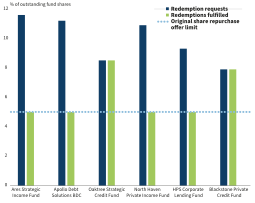
Q1 2026 redemption requests
Narrow escape routes
For individual investors, perpetual non-traded business development companies (BDCs) promised the best of both worlds. The semi-liquid funds offered exposure to private credit without the long lock-up periods of institutional funds or the volatility associated with listed lending vehicles. The funds will typically buy back up to 5% of outstanding shares per quarter, allowing some narrow escape routes for investors if needed.
The funds were marketed to wealthy individual investors looking for consistently higher returns than from conventional markets. However, exit requests have soared as the potential risks of some underlying loans, especially to the software sector, have hit the headlines, testing the structural basis of the funds.
Managers should hold their nerve when it comes to redemption caps, said Tristram Leach, head of investments for Europe at Apollo Global Management.
“The 5% number is there for a reason,” Leach told a Creditflux podcast. “It’s important to protect remaining investors. It’s a level of liquidity that has been promised. In general, we think the appropriate way to proceed is to do what you said you’d do.”
Leach, who is also co-head of European credit at Apollo, said the private credit market as a whole was slow to recognise the risks of concentrated software lending — that is until Anthropic began rolling out agentic AI features this year, raising concern about business disruption.
“We’ve been watching the incredible pace and development of large language models for several years now,” he said, adding that Apollo had a relatively conservative software exposure of 2%.

Managers should hold their nerve over redemption caps
Tristram Leach
Head of investments for Europe
Apollo Global Management
Individual investors have been more spooked by the negative turn in the narrative than institutions, which take their time in committing capital and deciding on strategy shifts. So far, most institutional investors are keeping faith with private credit as an asset class, according to market sources.
Credit quality was a consideration last year when retail investors started to pull out of listed BDCs, triggering a slide in share prices. But the prospect for lower returns in a falling interest-rate environment was also a key factor in that sell-off.
Redemption requests for semi-liquid funds are likely to stay elevated, as unsettling headlines keep swirling, said Larry Herman, managing director at Raymond James.
Managers have so far responded to the stress test in two ways — by capping redemptions at the stated limit or granting additional exit requests on an ad-hoc basis.
Perpetual non-traded BDCs primarily invest in illiquid credit assets, so overly hasty sales could destabilise a fund’s value, hence the standard limits on withdrawals. The caps also aim to prevent an unfair scenario in which early redeemers would receive full liquidity at the expense of those who persist with their investment.
As exit requests topped the stated limits, firms such as BlackRock/HPS, Apollo and Ares stuck with the 5% threshold, denying some investors full redemption. Those investors still wanting to exit will need to submit a request for the next quarter.
Some are being flexible
Continued high redemption volumes could eventually hurt leverage and liquidity in the funds, market sources say, predicting that attention will focus on which managers are flexing the rules and which are enforcing the constraints.
“Some managers appear to be providing more liquidity in hopes that it will ease pressure and reduce future redemption requests,” Herman said. “Others continue to report net inflows, though the key question is how long fundraising can continue at that pace.”
Investors will be watching the credit cycle and scouting for signs of broader economic woes, which could affect fundraising and performance, he added.
