



Listen to the latest episode of Credit Exchange with Lisa Lee

Published in London & New York
10 Queen Street Place, London
1345 Avenue of the Americas, New York

Creditflux is an
company
© Creditflux Ltd 2026. All rights reserved. Available by subscription only.


Event Leveraged Finance Fights Melanoma
LFFM event makes life-saving return
by Kathryn Gaw
Leveraged finance leaders meet in London to support the Melanoma Research Alliance, raising millions and spotlighting the breakthroughs that are now helping fight many types of cancer
On a January evening, under the iconic glass dome of the British Museum, the leveraged finance community drank champagne among the antiquities and discussed the latest innovations in cancer research.
For the past 15 years, Leveraged Finance Fights Melanoma (LFFM) has hosted glamorous events just like this in New York, raising millions of dollars to support the work of the Melanoma Research Alliance (MRA), while also raising awareness of the dangers of melanoma.

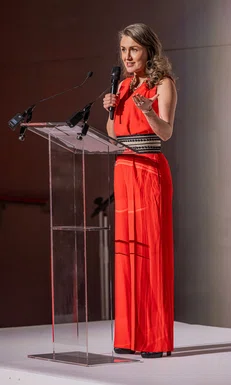
Above right: Roxana Mirica, LFFM co-chair and Apax Partners’ head of capital markets, gives her welcome speech
The New York events have grown in size and stature as more people began to recognise the extraordinary achievements of the charity. The first New York event was held in the Rockefeller Center, but more recently it has been upgraded to the Museum of Modern Art, MoMA. Likewise, in London the event quickly outgrew its original National Gallery venue and moved into the British Museum for its second outing.
This event, on 28 January, brought together an international crowd of more than 700 leveraged finance professionals to share their stories about the ways in which the MRA’s work has affected their lives.
Deep ties in leveraged finance
In her welcome speech, LFFM co-chair and Apax Partners’ head of capital markets, Roxana Mirica, described the MRA as a change-maker. The charity uses its funding to back talent and cutting-edge research which has a high chance of success. Its deep ties to the leveraged finance community are clear to see.
“For me, this has been a personal priority,” Mirica told Creditflux, the day after the event. Mirica’s father was diagnosed with stage four melanoma several years ago, which inspired her to get involved with melanoma research and facilitate LFFM London as a result.

Lives have been saved by the MRA
Even before then, she was familiar with the work of the MRA and LFFM. “I kept thinking, well, New York has this amazing LFFM event, I wonder why we don’t have it in London,” she said.
In fact, among those gathered at the British Museum, it was hard to find anyone who had not been impacted by cancers such as melanoma.
“There were a handful of people in that room whose lives have been directly saved by the MRA,” said Leo Wouters, LFFM co-chair and managing director in private credit strategy at General Atlantic.
These included Wouters’ boss Jeff Rowbottom, managing director of General Atlantic and an LFFM co-founder, who was diagnosed with melanoma 15 years ago. “Jeff’s story is mind-blowing,” said Wouters. “When he was diagnosed, Mike Milken and MRA put him in touch with doctors who found him a Phase I trial for immunotherapy. Back then, immunotherapy was an early stage, almost unheard-of treatment. Now immunotherapy is a primary treatment strategy used in over 30 cancer types.”


Milken, the so-called ‘Junk Bond King’, appeared via video link to praise the event’s organisers and speak about the great work being done by cancer charities such as the MRA.
To date, the MRA, which was founded in 2007, has directly invested more than USD 175m to support 500 projects across the world. This seed investment has led to another USD 535m of follow-on funding, which has led to the creation and roll out of breakthrough cancer treatments, including immunotherapy.
“These immunotherapies really set the stage,” said Dr Marc Hurlbert, the MRA’s CEO. “They were approved first in melanoma. Now they’re used in lung cancer, some types of breast cancer and 30 other different cancers. Now we can cure about half of patients with these metastatic melanomas.”
We can cure about half of patients
There has been amazing progress in melanoma research, Hurlbert added. “Since 2011, we’ve had 19 new drugs approved and that includes five different classes of drugs, and completely different modalities.”
The innovations continue, with the newest therapies being gentler on the body and easier to administer. They also improve survival rates and make treatment more manageable.
“We will get to the point within the next 10 or 15 years where we can convert these cancers from life-threatening to manageable, like diabetes,” said Hurlbert.
But there is so much more work to be done. The MRA is currently financing a new vaccine, which Hurlbert believes will be “critical” to the future of cancer treatment. These vaccine trials have been going on for almost a decade, stretching back to 2018, when Moderna began using mRNA trials in melanoma studies. Two years later, this research was diverted into developing a Covid vaccine.
Outsized returns
Leveraged finance professionals can spot an opportunity that will deliver outsized returns, and their backing of LFFM has delivered incredible results.
“The MRA is almost like a private equity investor,” said Mirica. “It does early-stage seed investing: finding the right scientists, giving them the grants that they need to effectively progress their research.”
Wouters has also noticed an interesting skills overlap between the leveraged finance market and the work of the MRA.
“This is a returns-based business, and they are very analytical around it,” he said. “But what is particularly incredible is to do that in almost a venture capital way, where they’re looking for approaches that have a very high promise, but are probably underserved by the market. So they’re looking at rare cancers, including uveal and mucosal melanoma.”
About melanoma
- Approximately 112,000 new cases of invasive melanoma are expected to be diagnosed in the US in 2026.
- Since the early 1990s, melanoma skin cancer incidence rates have increased by 147% in the UK.
- Approximately 90% of all melanomas are caused by ultraviolet radiation from the sun or indoor tanning devices.
- Since LFFM was founded in 2011, MRA-supported research has led to a new breakthrough treatment almost every year.
- The MRA has invested USD 175m to support 500 projects at universities in 19 countries.
- Approximately one third of the MRA’s funding has come from LFFM; 100% of every dollar and pound raised for the MRA goes directly towards cancer research.
- A total of GBP 1.6m was raised by LFFM London’s British Museum event; a record USD 4.2m was raised at the LLFM New York 2025 event.