




Listen to the latest episode of Credit Exchange with Lisa Lee
Published in London & New York
10 Queen Street Place, London
1345 Avenue of the Americas, New York
Creditflux is an
company
© Creditflux Ltd 2026. All rights reserved. Available by subscription only.


Data Secondary
Risk appetite softens after April surge while trading efficiency remains high
May volumes in the CLO secondary market were healthy compared to last year
Secondary volumes decline in US
The US CLO secondary market entered May 2026 with a noticeably softer tone after an exceptionally strong April, though underlying liquidity conditions remained historically constructive.
Trading volumes declined across most rating cohorts, spreads generally tightened modestly in higher-quality paper, and market participation appeared increasingly selective following the aggressive risk bid observed during the first quarter.
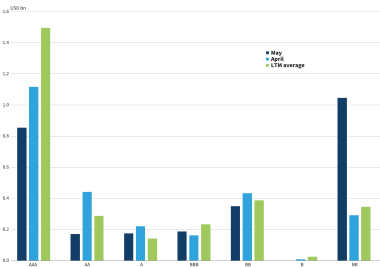
Triple A paper, which had reached approximately USD 1.11bn in April, declined to roughly USD 853m in May, representing a sequential contraction of more than 23%.
Traded US BWIC volumes
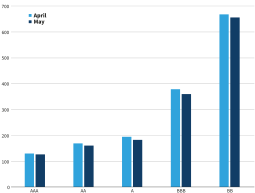
US BSL CLO DMs MoM (bps)
Tightening supply hurts activity
Spread behaviour during May reinforced the theme of selective risk-taking rather than wholesale de-risking. Discount margins tightened modestly across most senior tranches. Triple A DM levels compressed from approximately 131bps in April to 127bps in May, while double A spreads tightened from roughly 169bps to 161bps. Single A spreads also declined materially, falling from 194bps to 183bps.
The tightening in senior and upper mezzanine spreads contrasts with the decline in trading volume and suggests that reduced supply, rather than deteriorating demand, was the primary driver of lower activity levels. Investors appeared willing to pay tighter levels for high-quality paper even as fewer bonds circulated.
Triple B and double B spreads compressed modestly. The overall pattern indicates that investors continued extending down the capital structure, albeit with greater caution than earlier in the year.
Constructive market continues
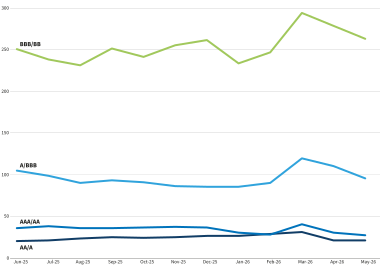
Net interest spread data showed stable market conditions. Triple A spreads averaged approximately 127bps in May, modestly below April’s 131bps reading.
Double A spreads compressed sharply as well, while triple B and double B spreads both moved tighter. The data collectively point toward a market that remains fundamentally constructive despite slower turnover.
Importantly, the May slowdown does not appear indicative of deteriorating market structure. Rather, the retrenchment follows an unusually active March-April period in which investors aggressively repositioned into CLO risk amid improving macro sentiment and stabilising credit fundamentals.
US BSL new issue spreads basis
US CLO BWICs trends
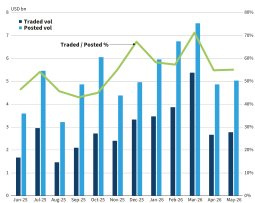
Market efficiency increases
Market efficiency metrics improved further during 2026. Through the year-to-date period, traded volume represented approximately 60% of posted volume, materially above the roughly 51% conversion ratio recorded during 2025. This improvement suggests stronger execution quality and deeper two-way liquidity despite somewhat lower headline turnover during May.
That dynamic is especially notable because tighter spreads would ordinarily be expected to reduce transactional urgency.
FINRA TRACE reported CLO/CDO volumes
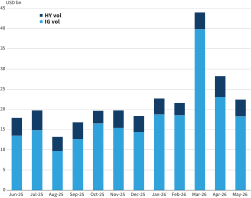
Normalisation in CLO secondaries
Broad TRACE market activity supports the interpretation of a still-supportive credit backdrop.
Investment-grade and high-yield trading volumes remain elevated versus many periods in 2025, though no longer accelerating at the pace observed earlier this year.
Overall, May 2026 reflected normalisation rather than deterioration in the CLO secondary market. Trading activity softened from April’s elevated levels, but the market remains well supported, while investors appear increasingly disciplined in risk selection.

For further information, contact Jacob Krayn, head of business development, Kopentech: Jacob.Krayn@kopentech.com
Source for all data: Kopentech, TRACE
